
Fire safety compliance is complex and demanding, with a swathe of requirements and regulations to consider. So, if you need help in ensuring that all bases are covered, our experts are here to help.
Join JLA’s fire safety specialists for a comprehensive guide to ongoing compliance and optimal safety. We’ll provide the framework for fire safety compliance in the UK, along with a variety of tips and insights that can help you to maintain and safeguard your business’ ongoing fire safety. Use the links below to navigate or read on for our full guide.
Key takeaways
- All businesses must have a “responsible person”, charged with overseeing fire safety compliance on their non-domestic business premises.
- All UK businesses must have written fire risk assessments regardless of size (since October 2023)
- Fire safety equipment requires professional servicing every 6 months under British Standards
- Maximum penalties include unlimited fines and 24 months imprisonment for serious breaches
- Fire alarm call points must be tested weekly during working hours
- Emergency lighting needs monthly testing and 3-year battery replacement cycles
- Staff require fire safety induction training on their first day of employment
Table of Contents
Understanding your legal obligations
Since commercial buildings are treated differently than residential properties in the UK, there is a whole swathe of additional legal requirements governing fire compliance and safety. As such, business leaders and key stakeholders must have a thorough understanding of fire safety legislation as it applies to non-domestic premises.
So, with that in mind, here’s a quick rundown of your current legal obligations as a business owner or building manager – some parts of which you may already be pretty familiar with.
Regulatory Reform (Fire Safety) Order 2005 (RRO)
The Regulatory Reform (Fire Safety) Order 2005 (RRO) remains the core pillar of fire safety legislation, governing all non-domestic properties in England and Wales specifically. When it was first launched way back in 2005, it replaced and incorporated 70 standalone pieces of legislation – a fact which demonstrates just how comprehensive and far-reaching the RRO framework is.
One of the most critical parts of the RRO framework that businesses need to understand is that the order puts emphasis on a “responsible person” to uphold compliant fire safety standards. Before the introduction of the order, there was some confusion about who is responsible for what – the RRO cleared this up, putting the onus on responsible persons to oversee fire safety compliance on their non-domestic business premises.
In practice, this means that the responsibility of maintaining fire safety compliance falls to business leaders, managers, supervisors, landlords, or general building staff, rather than fire safety authorities. So, naturally, one of the very first things you’ll need to do as a business is elect a responsible person – someone happy to take on the duty of maintaining fire safety compliance.
Some of the most common fire safety duties associated with a responsible person include:
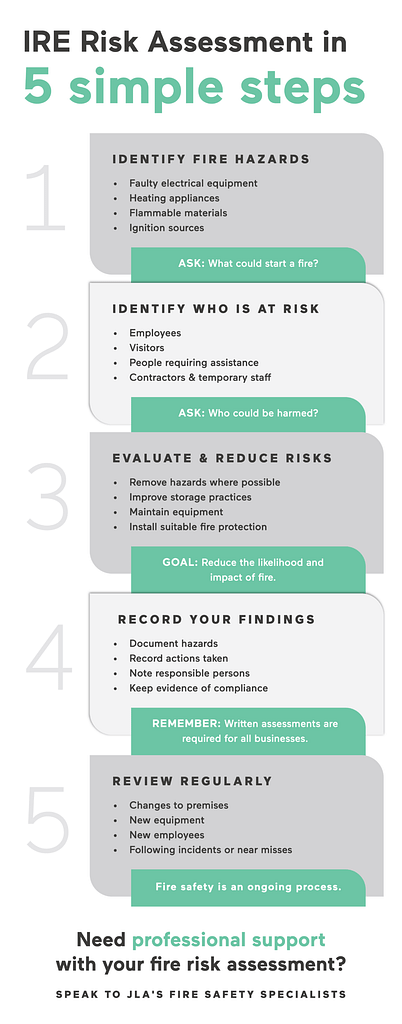
- Carry out a suitable and sufficient fire risk assessment and review it regularly.
- Identify fire hazards and those who may be at risk.
- Remove or reduce fire risks wherever reasonably practicable.
- Provide and maintain suitable fire detection and warning systems.
- Ensure appropriate fire-fighting equipment is available and maintained.
- Keep escape routes and emergency exits clear and usable at all times.
- Install and maintain emergency lighting where required.
- Develop emergency evacuation procedures.
- Provide employees with appropriate fire safety information and training.
- Appoint competent persons to assist with fire safety where necessary.
- Coordinate fire safety arrangements with other responsible persons occupying the same premises.
Fire Safety (England) Regulations 2022 Requirements
In the wake of the Grenfell Tower inquiry, several changes were made to the Fire Safety (England) Regulations 2022. Specifically, these changes incorporated new rules for quarterly fire door checks, wayfinding signage for emergency services, and mandatory electronic floor plans for buildings over 18m high.
Given that the deadline for implementing these changes has now passed, we would expect most business leaders reading this guide to be familiar with the new laws. If, however, you’ve recently moved to new premises which fall into this category, you may need to adjust your fire safety procedures to incorporate the required changes.
Conducting your mandatory fire risk assessment
Fire safety risk assessments are a fundamental part of achieving optimal fire safety and total regulatory compliance. They fall within the remit of your business’ responsible person, though it’s recommended that they’re carried out by an accredited professional in most instances, ensuring that all risks are identified and procedures put in place to maintain peak fire safety.
Here at JLA, we offer commercial fire safety risk assessments as part of our fire safety services. As such, we can help you identify fire hazards, at-risk persons, and dangerous substances and ignition points, before putting a fire action plan in place to help you maintain full FS compliance.
Learn more about fire safety risk assessments and the process involved via the guide linked above.
Essential fire safety equipment and standards
Fire safety is rightly discussed as a holistic system, with all parts working towards the same goal. But sometimes it’s helpful to look at the specific equipment and provisions needed to ensure optimal fire safety, so let’s do that now.
Fire detection systems
Early detection is the most effective way to inhibit the spread of fire and smoke, and curtail the potential damage these can cause. Of course, there are a variety of different commercial fire detection systems available, so the system you deploy must be suitable for your business type and application.
The following chart lists the various types of detection systems available, along with typical usage applications.
Category | Purpose | Typical Application |
L1 | Maximum life safety – detectors throughout all areas | Care homes, sleeping accommodation, high-risk premises |
L2 | Detectors in defined high-risk areas plus escape routes | Hotels, offices with identified risks |
L3 | Detectors in escape routes only | Lower-risk commercial premises |
P1 | Full property protection | Warehouses, storage facilities |
P2 | Protection in defined high-risk areas only | Server rooms, plant rooms |
M | Manual call points only | Simple, low-risk premises |
Fire extinguishers and suppression systems
Commercial fire extinguishers and comparable flame suppression systems are your first line of defence in reducing the spread of fire and smoke throughout your premises. They play a central role in an active fire safety system, giving you the opportunity to protect your most-valued assets before emergency services can arrive.
Of course, it’s common knowledge that there are many different types of fire extinguishers for professional use, so you’ll need to deploy the system that’s most appropriate for your business type. For instance, wet chemical fire extinguishers are designed for tackling Class F fires in commercial kitchens, while dry powder extinguishers are best suited to Class A, B, and C fires in offices and other use premises.
Take a look at our linked guide for a complete breakdown of the various types of fire extinguishers and their recommended applications.
Emergency lighting and escape route systems
There are various requirements that commercial business premises must meet to comply with fire safety regulations concerning emergency lighting, escape routes, and evacuation planning. For example, BS 5266-1 states that emergency lighting systems must provide up to three hours of illumination in the event of fire, while photo-luminescent exit signage is required to meet safety standards.
Your building’s fire safety evacuation plan falls to the responsible person, including both its initial inception and its ongoing maintenance and enforcement. Our guide on how to make a fire safety plan can steer you through the full process, from carrying out an initial fire safety risk assessment to routinely practising your evacuation plan to ensure it’s well-drilled should the worst happen.
Weekly and monthly testing requirements
Under the Regulatory Reform (Fire Safety) Order 2005, it’s expected that your responsible person should ensure that fire safety equipment is maintained in efficient working order and in good repair. This means regular testing is required to ensure that systems are always in an efficient state.
While the RRO doesn’t specify exact timings for all types of commercial fire safety equipment, it’s expected that active fire prevention devices are tested periodically on a weekly and monthly basis. Of course, your exact testing plan and schedule will depend on the scale of your fire safety system and its component parts.
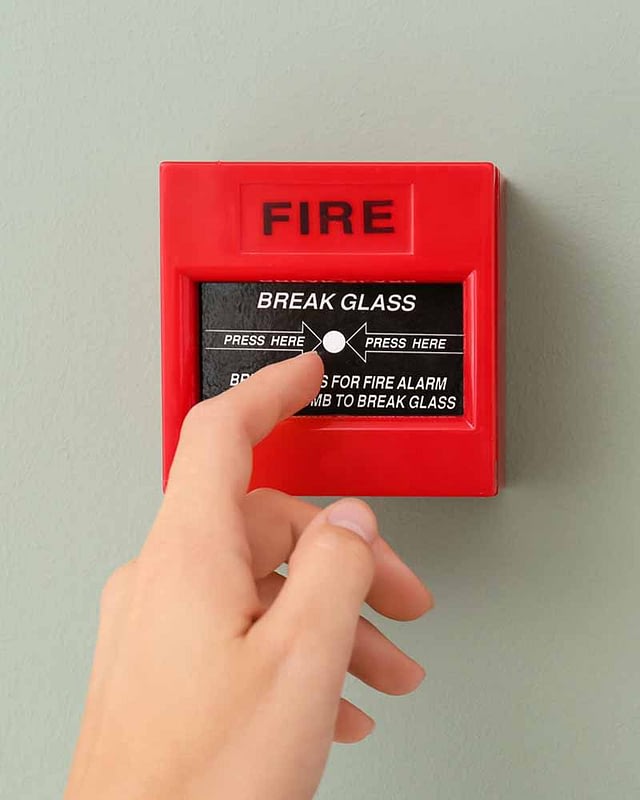
For example, fire alarm systems are usually tested weekly via a manual call point, to ensure that they’re working effectively. It’s common for such systems to be tested at the same time each week, often with a pre-test alert to staff to inform them that a drill is about to take place.
Elsewhere, fire doors and fire extinguishers are usually tested monthly with a visual inspection, ensuring that they’re in good working order with no signs of defects or anomalies. It’s important to drill full building evacuations periodically too (usually once a month) to ensure that your escape route, signage, and adjoining systems are working effectively.
Professional service requirements
As part of BS 5839-1 non-domestic fire safety legislation, businesses are required to have their on-site fire safety equipment inspected and serviced by a competent person at intervals not exceeding six months. However, do note that this is only a minimum servicing requirement; larger and more complex systems may require more frequent servicing to keep on top of individual elements.
When attending your premises, the fire safety service engineer will ask you to provide a log of any defects, false alarms, or building changes since their last inspection. They’ll inspect your system’s power supply status, fault indicator system, internal batteries, and display messages, while ensuring a steady connection between remote monitoring centres.
Here’s an additional breakdown of the component checks which are typically carried out as part of professional fire safety equipment servicing.
Equipment | Service Frequency | Standard | Key Checks |
Fire alarms | 6-monthly (minimum 2 per year) | BS 5839-1:2025 | Every detector, call point, sounder, panel logic, battery capacity, false alarms review |
Emergency lighting | Annual duration test (1 hour); 3-year full rated-duration test | BS 5266-1 | Battery capacity, illumination levels, failed units, wiring |
Fire extinguishers | Annual full service | BS 5306-3 | Pressure, seals, discharge test where applicable, 5-year overhaul |
Fire doors | Quarterly (communal) / Annual (flat entrance) in buildings over 11m | Regulation 10 | Gaps (3–4 mm sides/top, max 8 mm threshold), seals, closers, frame condition |
Compliance monitoring and inspections
Fire safety compliance is an ongoing, non-static process, with your business’ responsible person required to ensure that fire safety arrangements remain effective throughout the life of the building. Of course, external monitoring and inspections from industry bodies are a part of this, which is why logging and recording changes to your fire safety system is so crucial.
Typically, the simplest way to ensure solid fire safety compliance is to enlist the help of a third-party contractor. Fire safety specialists like JLA can provide a full suite of services, systems, and ongoing maintenance and monitoring, taking care of your building’s fire safety compliance while liaising closely with responsible persons.
FAQs
What is the maximum penalty for fire safety non-compliance in 2026?
In England and Wales, businesses face an unlimited fine and up to two years’ imprisonment for the worst breaches of fire safety. Note that both the business owner and the responsible person can be prosecuted for fire safety non-compliance.
How often must businesses conduct professional fire risk assessments?
While there’s no official requirement for fire risk assessments in the UK, it’s recommended that such inspections are carried out after changes to your business’ equipment, infrastructure, or after the onboarding of several new starters.
Can small businesses perform their own fire safety equipment maintenance?
Yes, some fire safety equipment maintenance can be conducted independently. However, this should only be relied on where people have the necessary competence, knowledge, and training.
How many Fire Marshals does my business legally require?
There’s no fixed requirement for the total number of Fire Marshals your business should have. This will depend on the size and complexity of your organisation, as well as the outcome of your most recent fire safety risk assessment.
What happens if a fire occurs without a valid risk assessment?
The outcome of this can be serious, and may result in enforcement action, prosecution, and significant penalties. If you need help with your fire safety risk assessment, book an inspection from our trained fire safety specialists today.
Do businesses under 5 employees need fire safety logbooks?
No, a fire safety logbook isn’t required for micro businesses in the UK. However, they must still comply with the Regulatory Reform (Fire Safety) Order 2005 (FSO).
Fire safety is a multi-faceted and complex part of running a business in the UK, so it’s recommended to seek assistance from external specialists where required. If you need help with your ongoing fire safety system, contact JLA today on 0808 239 7578.

Mark Bone
Operations Director Mark joined JLA in 2019 and now manages the delivery of turnkey fire safety and security systems designed to protect people, premises and critical assets.
Drawing on his extensive technical, commercial and customer service experience, Mark helps clients with everything from system selection and project planning to ongoing maintenance, ensuring they can navigate complex operating challenges.
In a shifting regulatory landscape, Mark also provides a wealth of safety-first guidance, with a particular focus on reducing risk and strengthening compliance across every site.