
In early 2026, UK fire door regulations underwent some of the biggest regulatory changes in years. This came about through the phasing out of old British testing standards and stricter enforcement under the Building Safety Act and Fire Safety Act.
Since it’s been several years since we discussed fire doors here on the JLA blog, we thought it was high time we revisited the topic to make sure our readers are primed on the important updates and amendments that have come into effect. You’ll find key takeaways down below, along with further information and analysis from our fire safety professionals.

Key takeaways
- Building Safety Regulator becomes independent from HSE on January 27, 2026
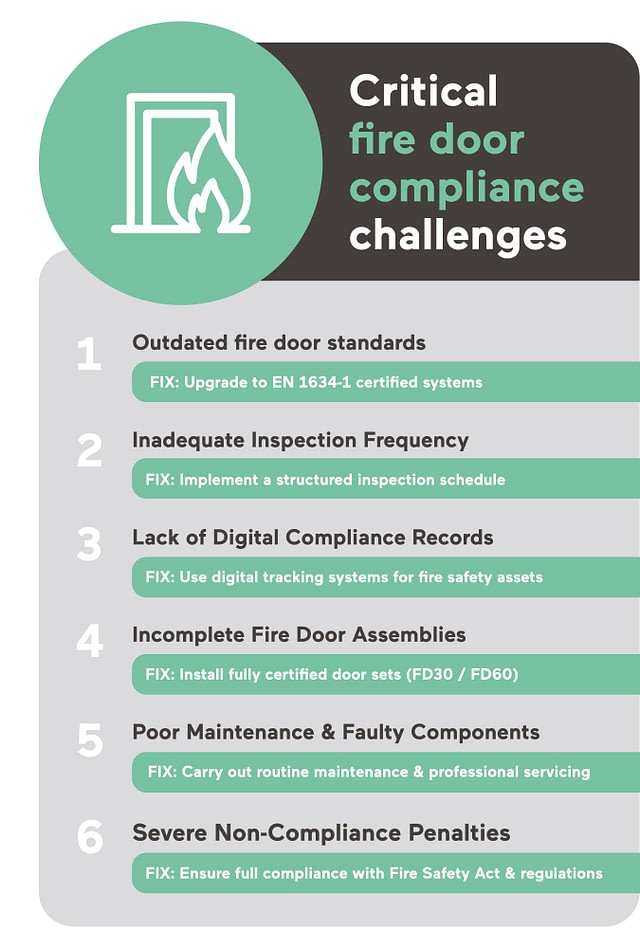
- BS 476-22 fire door testing standard withdrawn – replaced by EN 1634-1
- Quarterly fire door inspections mandatory for buildings over 11 metres in height
- Digital “Golden Thread” documentation required for all fire safety equipment
- Non-compliance penalties include unlimited fines and up to 2 years’ imprisonment
- FD30 and FD60-rated doors must include certified frames, seals, and hardware as complete assemblies
Table of Contents
What are UK fire door regulations in 2026?
Before we introduce the latest changes to fire door regulations for 2026, we wanted to clarify the main legal framework for fire door safety in the UK. Several guidelines inform the rules and regs around commercial fire doors, including the following.
UK fire door regulations in 2026 are based on wording from the Regulatory Reform (Fire Safety) Order 2005, the Fire Safety Act 2021, and the Fire Safety (England) Regulations 2022. Other rules have also been introduced in light of the Grenfell Tower fire response reforms.
Regulatory changes: What’s new?
While significant fire door rule changes were introduced in 2023, 2026 saw a major technical update to British Standard BS 8214. What’s more, the BSR (Building Safety Regulator) also separated from HSE at the start of the year, a move that brought changes to enforcement powers and inspection frequency.
Learn more about 2026’s regulatory updates right here…
Independent Building Safety Regulator
As alluded to earlier, the BSR broke free from the HSE in January 2026, paving the way for enhanced enforcement powers, more frequent building inspections, and more centralised coordination with local fire and rescue services.
Technical standards update
BS 476-22 was withdrawn in March 2026, replaced by the new EN 1634-1 for commercial fire doors. The update brought several revisions to how fire doors are installed and maintained, along with a significant new focus on the entire tested door system, not just the door leaf.
Digital documentation requirements
As part of the UK’s post-Grenfell fire safety reforms, a new “Golden Thread” system was introduced, requiring accurate and continuous digital record-keeping of a building’s safety-critical information. JLA customers can rely on full integration with our digital monitoring platforms to ensure full compliance with the new Golden Thread regulatory guidelines.
Fire door inspection regulations UK
Now that we’ve outlined the core changes to fire door safety regulations in the UK, let’s take a closer look at the rules and regulations that all commercial building managers must be aware of.
Mandatory inspection frequencies
There are now variable fire door inspection frequencies for different commercial premises in the UK, including:
- Buildings over 11m: Quarterly inspections for communal areas
- Buildings over 11m: Annual inspections for flat entrance doors
- Commercial buildings: Six-monthly professional inspections per BS 9999
- High-traffic areas: Monthly visual checks recommended
Inspection checklist and requirements
If you have a fire door inspection on the horizon, it can be useful to know exactly what safety regulators will be assessing on your premises. This is an up-to-date checklist, detailing the priority points for fire safety inspectors as of 2026:
- Gap tolerance measurements using certified gauges
- Intumescent strip and smoke seal condition assessment
- Self-closing device functionality testing
- Third-party certification label verification
- Hardware compatibility and fire rating checks
Commercial fire door regulations UK
Commercial business premises have their own unique fire door safety requirements, so it’s important to stay up to speed on current legislation to ensure your business remains compliant.
With that in mind, let’s take a closer look at the latest rules and guidelines for fire door safety on commercial premises in the UK.
Responsible person duties
Responsible person duties for commercial fire door safety stem from the RRO 2005 and the Building Safety Act 2022. Specifically, these guidelines outline the duties that competent parties must perform to ensure doors are fire safe, along with the liability and enforcement consequences that can stem from failure to comply with these regulations on the part of your business’s responsible person.
Workplace-specific requirements
Commercial fire door safety legislation splinters into separate, standalone guidance depending on the type of business and its workplace. For instance, office buildings have significantly different fire door safety requirements than, say, hotels or manufacturing sites, so it’s critical that you fully understand the exact requirements for your workplace and premises types – all of which can be found in the RRO 2005 and the Building Safety Act 2022.
Kitchen fire door regulations UK
Commercial kitchens have unique fire door safety requirements, particularly given the presence of steam, smoke, and grease. It’s therefore super critical that any self-closing mechanisms are regularly checked and maintained, particularly in high-traffic areas.
Of course, commercial kitchen fire door safety is closed link to other active and passive fire control measures, including ventilation and fire suppression systems. JLA’s fire safety experts can advise on a fully tailored solution for your commercial kitchen, including HVAC upgrades and fire door inspections, maintenance, and installation.
Fire door ratings and technical requirements
The deployment of different types of commercial fire doors throughout your business premises is critical to ensure complete compliance and safety. Typically, there are two types of fire door ratings that you need to know, each suited to different applications around your premises.These include.
Rating | Fire resistance | Typical thickness | Common applications | Smoke seal version |
FD30 | 30 minutes | Generally 44mm | Standard internal office doors, residential flat entrances, and lower-risk compartment lines. | FD30s |
FD60 | 60 minutes | Usually 54mm | Protected stairwells, plant rooms, high-risk areas, and buildings over 11m where required. | FD60s |
Complete door set requirements
Over the past year or so, there’s been a significant shift towards complete door set compliance for commercial fire doors, as opposed to outdated rules which focused almost exclusively on the integrity of door leaves.
Historically, the door leaf was considered the most important aspect of fire door safety; provided this element met industry standards, it could be combined with existing components. Today, however, things have changed; inspectors test the complete door set, so all parts must be compliant and in line with industry standards.
At JLA, we provide fully tested door sets, including the leaf, frame, seals, hinges, locks, closers, and fixings. Our fire safety experts also work to new installation guidelines for complete door sets, taking into account thresholds, gap tolerance, and product set traceability.
Compliance and penalties
Before we draw our guide to UK fire door regulations to a close, we thought it was worth reiterating the potential penalties for non-compliance that UK businesses face. There are some significant legal consequences to be aware of here, which add weight to the importance of full fire door safety compliance.
Potential legal penalties for non-compliance with fire door legislation include:
- Unlimited fines for businesses or persons in breach of fire door safety standards
- Prison sentences of up to 24 months, depending on the severity of the breach
- Serious implications for your insurance, along with exposure to liability
- Enforced premises closure, withdrawal of licences, and related prohibition orders
Professional fire door services and maintenance from JLA
JLA provides fully accredited fire safety solutions, products, and services for UK businesses, including full fire door sets for businesses in every industry sector. Our fire safety specialists provide BAFE and third-party-accredited installation services, along with emergency support and full integration with our suite of digital asset management tools.
Need help with your fire safety compliance? We can help. Whether you manage a commercial kitchen or a large manufacturing site, our fire safety advisers can offer guidance and expertise on all areas of your fire safety infrastructure. Get in touch today on 0808 239 7578 to learn more.
FAQs
How often must fire doors be inspected in commercial buildings?
Generally, it’s advised that fire doors be inspected every quarter in commercial buildings. However, this will depend on the type of premises; for instance, in communal areas where residents live (say, a care home or health facility), fire doors must be checked every three months.
What happens to fire doors tested under BS 476-22 after 2026?
Fire doors tested under the outgoing BS 476-22 standard did not automatically become non-compliant following January’s rule changes. Instead, businesses have until September 2029 to ensure that all doors tested under BS 476-22 are upgraded to the new EN 1634-1 standard.
Who can legally install or repair fire doors under the 2026 regulations?
While there’s no standardised law governing who can legally install or repair commercial fire doors in the UK, this work must be carried out by a competent party. Typically, you should look for engineers with accreditations like BAFE, FIA, IFC, CHAS, BM TRADA, and Smoke Control Association – all of which you’ll find at JLA.

Mark Bone
Operations Director Mark joined JLA in 2019 and now manages the delivery of turnkey fire safety and security systems designed to protect people, premises and critical assets.
Drawing on his extensive technical, commercial and customer service experience, Mark helps clients with everything from system selection and project planning to ongoing maintenance, ensuring they can navigate complex operating challenges.
In a shifting regulatory landscape, Mark also provides a wealth of safety-first guidance, with a particular focus on reducing risk and strengthening compliance across every site.