

Amid the pressures of running a successful hotel or guesthouse, it can be hard to identify issues that are stymying opportunities for growth. But in our experience, outdated laundry equipment could be the root cause of ongoing inefficiencies and bottlenecks.
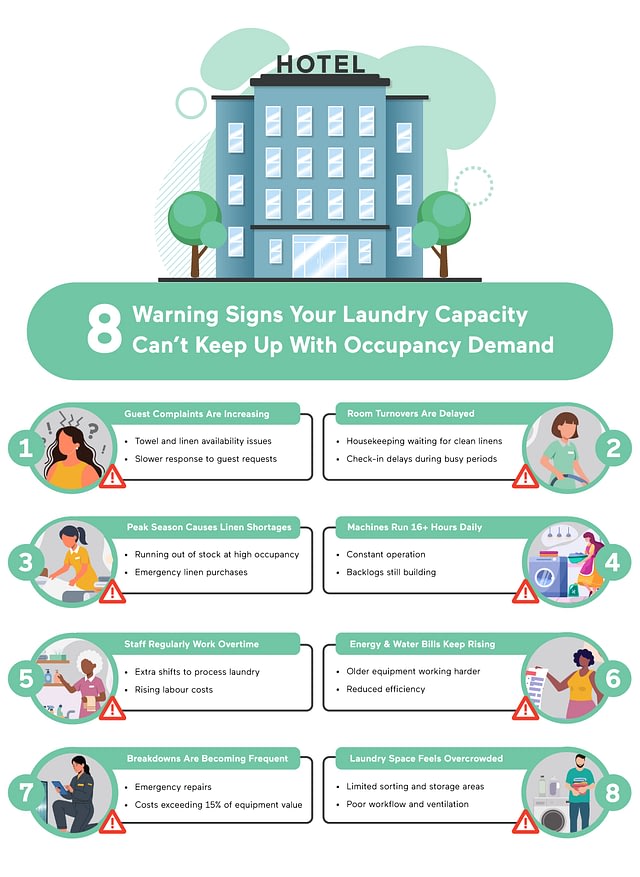
Here, we’re presenting a variety of signs and symptoms that could indicate that laundry-related issues are threatening your hotel’s performance and efficiency. We’ll highlight direct and indirect problems that can take root in the hotel laundry room, along with tips and guidance to help you upgrade your equipment in the most cost-effective way possible.

Key challenges at a glance
- Hotels processing over 85% machine capacity daily are operating beyond sustainable limits
- Guest satisfaction drops 23% when fresh towels aren’t available within 30 minutes of request
- Outdated laundry equipment uses 40% more energy than modern commercial systems
- Peak season linen shortages indicate immediate need for capacity expansion
- Maintenance costs exceeding £500 monthly per machine signal replacement requirements
- Staff overtime costs often exceed new equipment lease payments within 6 months
Table of Contents
Guest experience warning signs
Where else to begin than with the most detrimental warning sign that your hotel laundry is no longer sufficient or equipped to handle current capacity – the impact this is having on the overall guest experience.
Hotel laundries are unique in that their performance, output, and results are public-facing. Thus, even the smallest daily inefficiencies can have a knock-on effect, with the potential to negatively impact your business in the short and long term.
If your laundry room is no longer delivering the results and efficiency your guests expect, you may encounter the following early warning signs…
Direct guest complaints about towel and linen availability and quality
As worst-case scenarios go, direct complaints from guests regarding the quality or availability of towels and linens are as bad as it gets. If your laundry simply cannot meet the demands that guests may have for spare towels or clean linens, this is the number one indicator that your laundry room setup needs addressing with immediate effect.
Of course, the quality of guest linens and towels also matters, particularly in well-rated hotels with a star rating and reputation to consider. If linens and towels are notably worn and threadbare through over-processing, this could indicate an issue with your inventory. Of course, it could also be a sign that your commercial washing machine or dryer is outdated and lacks the programmes needed to process different fabric types gently and safely.
Problems with room turnover times
The turnover process is critical in the smooth running of your hotel, as it ensures you can maintain your quoted check-in times. If, however, you regularly experience delays or are constantly down to the wire trying to turn rooms around, this could signal that your laundry room is at capacity and in need of an upgrade or two.
Think about it: if outdated or too-small laundry equipment is creating a bottleneck in your turnover cycle, this creates additional stress for your backroom hospitality staff. It could even mean delays at the check-in desk, as well as an overall drop in guest experience and in-room quality.
Another potentially unforeseen consequence of an inefficient room turnover process concerns resourcing and over-staffing. Your business could easily waste money on additional staff or overtime hours in an effort to mitigate scheduling issues, when, in reality, the problem could be solved at source by upgrading your commercial laundry equipment.
Operational efficiency red flags
While increased guest complaints are the worst-case scenario signalling a serious problem with your laundry workflow, the signs and symptoms can begin much sooner. Indeed, you may encounter efficiency red flags well before issues trickle down to the guest-facing level, but it’s important to deal with these sooner rather than later to mitigate their potential impact.
There are a variety of tell-tale signs that your current hotel laundry room setup isn’t as efficient as it might be. Let’s take a closer look at some of the most common issues that hoteliers and laundry room staff might face…
Equipment running for longer than expected – and still causing delays
If you and your staff find that you’re having to run wash and dry cycles on a near-continuous basis, this could indicate a capacity issue – especially if you’re still struggling to cope with demand.
We cannot stress enough the importance of investing in commercial laundry equipment that is of the right capacity for your business. If your washing machine or tumble dryer isn’t rated for the average load weight that you regularly need to process, this will mean a more inefficient laundry workflow, with a greater number of cycles required to manage your overall daily throughput.
Hotel laundry rooms may experience capacity issues during peak times, or as a result of recent growth. So, upgrading your laundry setup may simply be a case of requiring bigger machines that can handle larger loads – ultimately helping to expedite your total processing times.
Staff working overtime to meet demand
As alluded to earlier, if you find that your staff are having to work overtime to meet demand, this could certainly signal an efficiency issue with your laundry room setup. There are a variety of negative knock-on effects, too, including:
- Drop in staff morale as a result of busy and inefficient working conditions
- Money wasted on overtime pay or additional recruitment needs
- Overall drop in output quality, which could affect guest experience
- Reduced standards across your laundry room – including hygiene and cleanliness
- Damage or premature wear to laundry equipment as a result of inefficient, at-capacity operation
Manual, inefficient workarounds becoming the norm
Consider your current laundry room setup and workflow – are there any areas where you’re reliant on manual processes and non-standard workarounds that your team has had to implement due to equipment shortfalls?
It’s not uncommon for laundry room staff to seek on-the-fly solutions to day-to-day issues, especially if they’re struggling to keep pace with demand. This, however, puts efficiency, hygiene, and cleanliness at risk, as well as potentially subjecting your equipment to premature wear and tear.
Of course, this could also mean you’re missing out on the opportunity to automate key processes around your laundry room, be it auto-dosing laundry detergent or smart wash/dry cycles. There are a variety of modern laundry solutions which can help eliminate time- and resource-intensive processes from your laundry suite, speeding up processes and freeing staff up to focus on other areas of your operations.
Workflow disruption indicators across your wider business
Hotel laundry inefficiencies can easily spill out from your laundry room, affecting other areas of your business both directly and indirectly. Of course, the biggest issue is workflow disruption – when failings in your laundry suite impact other core offerings and services around your hotel.
Let’s take a closer look at some of the issues that might arise:
- Housekeeping staff kept waiting for clean linens and towels before beginning the daily turndown process, impacting guest experience and scheduling.
- Core departments, like spa facilities and restaurants, compete for towels and linens, putting undue stress on internal teams.
- External laundry services are increasingly relied on to handle day-to-day laundry processing, reshaping how your business’ key workflows operate.
The financial impact analysed
Maintaining an optimal guest experience may be a priority, but the financial impact of a poorly performing hotel laundry room must be considered, too. Higher energy bills, unexpected costs, and dwindling profits can all stem from an outdated or at-capacity laundry suite, so let’s explore how inadequate laundry capacity can affect hotel finances.
The following cost comparison chart highlights the economic benefit of upgrading your hotel’s laundry room equipment…
Cost category | Ageing/overloaded setup | Modern efficient setup | Potential saving |
Energy per kg processed | 0.8–1.2 kWh/kg electrical | 0.3–0.5 kWh/kg electrical | Up to 60% |
Water usage | 30-40 litres per kilogram | 15-25 litres per kilogram | 30–40% |
Maintenance (% of RAV) | 5–10%+ | 2–5% | Significant reduction |
Staff overtime | Regular/mandatory | Occasional/seasonal only | Labour cost stabilised |
Linen replacement cycle | Accelerated (premature wear) | Standard lifespan achieved | Lower annual replacement spend |
Equipment performance issues
While capacity is usually the key culprit behind hotel laundry room inefficiency, technical issues could be stymying performance too.
If there’s an underlying fault with any of your equipment or your appliances haven’t been serviced and maintained regularly enough, then ongoing equipment performance issues could be behind recent poor results – perhaps signalling that it’s time for an upgrade.
The signs and symptoms of poorly performing laundry equipment include:
Issues | Explainer |
Longer-than-expected cycle times | When a washing machine or tumble dryer develops a fault, this could materialise as longer-than-expected cycle times, with the potential to significantly impact your laundry workflow. |
Frequent breakdowns | Often find yourself at the mercy of temperamental laundry equipment that is prone to frequent breakdowns? Your business cannot afford extended downtime, so it could be time for an upgrade. |
Inconsistent results | Hotel laundries need to deliver consistent results that reflect the establishment’s guest rating. If you’re not happy with your laundry room’s output, then outdated machinery could be the root cause. |
Excessive noise and/or vibration | You need to provide a safe and healthy working environment for your staff, while ensuring that guest ambience isn’t compromised by noisy laundering activity. If any of your laundry appliances is making excessive noise or producing a lot of vibration, this could indicate a serious fault that needs addressing ASAP. |
Occupancy vs required capacity benchmarks
Given that the majority of issues outlined in this guide come about as a result of inadequate laundry room capacity, we thought it would be useful to provide a rough industry benchmark that hoteliers can use to plan their next laundry room upgrade. Of course, this is rough, illustrative guidance only, so if you require bespoke help based on your exact requirements, the JLA team is always here to help.
Hotel size | Estimated daily linen volume | Minimum washer capacity needed | Key considerations |
Up to 50 rooms | 150–300 kg | 2× commercial washers (16–24 kg) | Efficiency and space optimisation critical |
50–150 rooms | 300–900 kg | 3–5× commercial washers (24–35 kg) | Dryer and ironer capacity must match |
150–300 rooms | 900–2,000 kg | Industrial-scale washer-extractors | High G-force extraction essential for throughput |
300+ rooms | 2,000+ kg | Full industrial laundry line | Complete system including ironers, folders, stackers |
FAQs
How do I calculate if my hotel's laundry capacity matches occupancy needs?
There are a variety of ways to calculate your hotel’s daily laundry capacity requirements. These include:
- Calculate your average occupancy versus the total number of rooms
- Weigh your daily laundry throughput over a typical seven-day laundry cycle, factoring in peak and off-peak occupancy periods
- Lean on smart energy meter consumption data to help you figure out how regularly appliances are used
Provided you have a rough idea of your hotel’s average laundry throughput and your average weekly occupancy rate, it’s possible to calculate your total laundry capacity. Just make sure to leave around 10-20% headroom to account for peaks in demand or business growth.
What's the average lifespan of commercial hotel laundry equipment?
High-quality commercial hotel laundry equipment should last 10-15 years depending on its average usage and whether it’s maintained and serviced within manufacturer guidelines.
When do maintenance costs justify equipment replacement over repairs?
If maintaining your hotel room’s laundry equipment has become a significant overhead, it may be time for an upgrade. For instance, if a single repair costs over 50% of the machine’s total value, this is definitely a sign that a replacement would be more cost-effective.
How quickly can new laundry systems be installed without operational disruption?
Very quickly, provided you opt for a professional installation. At JLA, our trained engineers will aim to deploy your new laundry equipment with minimal downtime and disruption, at a time that suits you. Of course, the actual installation time will vary depending on the work involved and the complexity of the install.
What energy efficiency improvements can modern laundry equipment provide?
We recently published a guide exploring the various ways that hotel laundry rooms can improve their energy efficiency by adopting modern commercial laundry equipment. Take a look at the full resource right here.
How does JLA's Total Care service compare to traditional equipment purchase options?
Total Care from JLA is designed to offer a complete, all-inclusive equipment procurement service, rather than simply a financing option. It offers brand-new equipment and professional installation, along with the following benefits:
- Free equipment servicing and maintenance every year
- 24/7 support from the JLA team
- Access to myJLA for on-demand equipment reporting and monitoring
- Emergency repair cover, with a guaranteed engineer response time within 8 hours
We hope this guide proves useful for hoteliers and laundry managers who may be struggling with an inefficient and at-capacity laundry room. If you decide it’s time to upgrade, contact our experts today on 0808 239 7578, and we’ll be happy to help.