
• About us
    • Back
    • Careers
    • ESG
    • Accreditations
    • Testimonials
    • Blog
    • Back
  • Solutions
    • Back
    • JLA Total Care
    • JLA Response
    • Compliance services
    • Flexible payment systems
    • Repairs
    • Back
  • Sectors
    Back
      • Care Homes
      • Contract Cleaners
      • Education
      • Equine and Stables
      • Facilities Management
      • Football Clubs
      • NHS and Healthcare
      • Health Clubs
      • Holiday Parks
      • Hotels & Spas
      • Housing
      • Launderettes
      • Prisons
      • Pubs & Restaurants
      • Public Sector
      • Vets & Animal Care
    Back
  • icon_20x20new_call0808 239 7578
  • comment-questionHelp
  • icon_20x20new_searchSearch
  • icon_20x20new_myjlamyJLA
    • Back
    • Manage your account online with MyJLA

      myJLA supports the smooth running of your business, with statements, job sheets, site information and essential documents all in one place.

      Sign in
      Register your interest
    • Back
JLA
  • Laundry
    Back
      • Commercial washing machines
      • Coin-operated washing machines
      • Barrier washers
      • Stacked systems
      • View all commercial washing machines
      • Commercial tumble dryers
      • Coin operated tumble dryers
      • Stackable
      • Safe technology
      • View all commercial tumble dryers
      • Commercial irons
      • Dryer ironers
      • Rotary irons
      • Hand finishing equipment
      • View all commercial Irons
      • Infection control
      • Medical macerators
      • Bedpan washers
      • Air filtration systems
      • View all infection control
      • OTEX
      • Laundry
      • Mould compliance
      • View all OTEX
      • Laundry solutions
      • Contactless laundry equipment
      • Commercial laundry service contracts
      • Managed laundry solutions
      • Microplastic filter
      • Launderette equipment
      • Drying cabinets
    Back
  • Catering
    Back
      • Cooking appliances
      • Commercial ovens
      • Commercial fryers
      • Commercial grills
      • Commercial griddles
      • Commercial hobs
      • Commercial induction
      • Bratt pans
      • Fridges & freezers
      • Commercial fridges
      • Commercial freezers
      • Commercial ice machines
      • Blast chillers
      • Food warmers
      • Bain Maries
      • Hot Cupboards
      • View all food warmers
      • Dish & glasswashers
      • Commercial Dishwashers
      • Glasswashers
      • Utensil washers
      • Catering solutions
      • Commercial kitchen installation
      • Kitchen furniture
    Back
  • HVAC
    Back
      • Heating
      • Boilers
      • Wall mounted
      • Floor standing
      • Hybrid heating systems
      • Commercial boiler service contracts
      • Total care for heating
      • View all heating
      • Hot water
      • Hot water cylinders
      • Water storage heaters
      • Sterile equipment services
      • Air conditioning
      • Commercial air conditioning
      • Commercial air conditioning service contracts
      • Air handling units
      • Cellar cooling systems
      • Total Care for air conditioning
    Back
  • Fire & security
    Back
      • Fire
      • Emergency lighting
      • Fire extinguishers
      • Fire alarms
      • AOV systems
      • View all fire safety
      • Passive fire safety
      • Commercial fire doors
      • View all passive fire safety
      • Fire risk assessments
      • Fire safety training
      • Security systems
      • Building services
      • Electrical services
    Back
  • Detergents
    Back
      • Laundry detergents
      • Commercial laundry detergents
      • Auto dosing pumps
      • Catering detergents
      • Commercial kitchen chemicals
    Back
  • Call us free:
    01422822282
Get a quote
JLA
Call us free:
01422822282
  • Commercial laundry equipment
    • Commercial washing machines
      • Coin-operated washing machines
      • Barrier washers
      • Stacked systems
      • Commercial washing machines
    • Commercial tumble dryers
      • Coin-op dryers
      • Stackable
      • Safe technology
      • All commercial dryers
    • Commercial irons
      • Dryer ironers
      • Roller ironers
      • Hand Finishing Equipment
    • Infection Control
      • Medical macerators
      • Bedpan washers
      • Air filtration systems
      • View all infection control
    • OTEX
      • Laundry
      • Mould compliance
      • View all OTEX
    • Contactless Laundry Equipment
    • Managed laundry solutions
    • Launderette equipment
    • Drying cabinets
    • Microplastic filter
    • Commercial laundry service contracts
  • Commercial catering equipment
    • Cooking appliances
      • Commercial combi ovens
      • Combi
      • Commercial range ovens
      • Commercial convection ovens
      • Commercial fryers
      • Commercial grills
      • Commercial griddles
      • Commercial hobs
      • Commercial induction hobs
      • Bratt pans
    • Refrigeration
      • Commercial fridges
      • Commercial freezers
      • Commercial ice machines
      • Blast chillers
    • Dishwashers & glasswashers
      • Commercial dishwashers
      • Undercounter dishwashers
      • Passthrough dishwashers
      • Commercial glasswashers
      • Utensil washers
    • Food warmers
      • Bain Maries
      • Hot Cupboards
      • View all food warmers
    • Water boilers
      • JLA water boiler
    • Modular
    • Furniture
    • Commercial kitchen design
  • HVAC
    • Commercial heating
      • Commercial boilers
      • Hot water cylinders
      • Water storage heaters
      • Hybrid heating systems
      • Commercial boiler service contracts
      • Total care for heating
    • Commercial air conditioning
    • Commercial air conditioning service contracts
    • Air handling units
    • Cellar cooling systems
    • Total Care for Air Conditioning
    • Sterile Services
  • Fire & security
    • Fire
      • Emergency lighting
      • Fire extinguishers
      • Fire alarms
      • AOV systems
    • Passive fire safety
      • Commercial fire doors
    • Fire risk assessments
      • Fire safety training
    • Commercial security systems
    • Building services
    • Electrical services
  • Detergents
    • Laundry detergents
    • Auto dosing-pumps
    • Catering detergents
  • Solutions
    • Total Care
    • JLA Response
    • Compliance services
    • Flexible payment systems
    • Repairs
  • About us
    • Careers
    • ESG
    • Accreditations
    • Testimonials
    • Blog
  • Sectors
    • Care Homes
    • Hotels & spas
    • Pubs & restaurants
    • Education
    • Holiday parks
    • Health clubs
    • Housing
    • Facilities management
    • Football clubs
    • Launderettes
    • NHS & Healthcare
    • Prisons
    • Public sector
    • Vets & animal care
    • Equine and Stables
  • Help
  • MyJLA
  • Contact
  • Commercial laundry equipment
    • Commercial washing machines
      • Coin-operated washing machines
      • Barrier washers
      • Stacked systems
      • Commercial washing machines
    • Commercial tumble dryers
      • Coin-op dryers
      • Stackable
      • Safe technology
      • All commercial dryers
    • Commercial irons
      • Dryer ironers
      • Roller ironers
      • Hand Finishing Equipment
    • Infection Control
      • Medical macerators
      • Bedpan washers
      • Air filtration systems
      • View all infection control
    • OTEX
      • Laundry
      • Mould compliance
      • View all OTEX
    • Contactless Laundry Equipment
    • Managed laundry solutions
    • Launderette equipment
    • Drying cabinets
    • Microplastic filter
    • Commercial laundry service contracts
  • Commercial catering equipment
    • Cooking appliances
      • Commercial combi ovens
      • Combi
      • Commercial range ovens
      • Commercial convection ovens
      • Commercial fryers
      • Commercial grills
      • Commercial griddles
      • Commercial hobs
      • Commercial induction hobs
      • Bratt pans
    • Refrigeration
      • Commercial fridges
      • Commercial freezers
      • Commercial ice machines
      • Blast chillers
    • Dishwashers & glasswashers
      • Commercial dishwashers
      • Undercounter dishwashers
      • Passthrough dishwashers
      • Commercial glasswashers
      • Utensil washers
    • Food warmers
      • Bain Maries
      • Hot Cupboards
      • View all food warmers
    • Water boilers
      • JLA water boiler
    • Modular
    • Furniture
    • Commercial kitchen design
  • HVAC
    • Commercial heating
      • Commercial boilers
      • Hot water cylinders
      • Water storage heaters
      • Hybrid heating systems
      • Commercial boiler service contracts
      • Total care for heating
    • Commercial air conditioning
    • Commercial air conditioning service contracts
    • Air handling units
    • Cellar cooling systems
    • Total Care for Air Conditioning
    • Sterile Services
  • Fire & security
    • Fire
      • Emergency lighting
      • Fire extinguishers
      • Fire alarms
      • AOV systems
    • Passive fire safety
      • Commercial fire doors
    • Fire risk assessments
      • Fire safety training
    • Commercial security systems
    • Building services
    • Electrical services
  • Detergents
    • Laundry detergents
    • Auto dosing-pumps
    • Catering detergents
  • Solutions
    • Total Care
    • JLA Response
    • Compliance services
    • Flexible payment systems
    • Repairs
  • About us
    • Careers
    • ESG
    • Accreditations
    • Testimonials
    • Blog
  • Sectors
    • Care Homes
    • Hotels & spas
    • Pubs & restaurants
    • Education
    • Holiday parks
    • Health clubs
    • Housing
    • Facilities management
    • Football clubs
    • Launderettes
    • NHS & Healthcare
    • Prisons
    • Public sector
    • Vets & animal care
    • Equine and Stables
  • Help
  • MyJLA
  • Contact
Get a quote

Month: August 2026

George Barclay
  • George Barclay
  • Laundry Expert

Amid the pressures of running a successful hotel or guesthouse, it can be hard to identify issues that are stymying opportunities for growth. But in our experience, outdated laundry equipment could be the root cause of ongoing inefficiencies and bottlenecks.

Here, we’re presenting a variety of signs and symptoms that could indicate that laundry-related issues are threatening your hotel’s performance and efficiency. We’ll highlight direct and indirect problems that can take root in the hotel laundry room, along with tips and guidance to help you upgrade your equipment in the most cost-effective way possible.
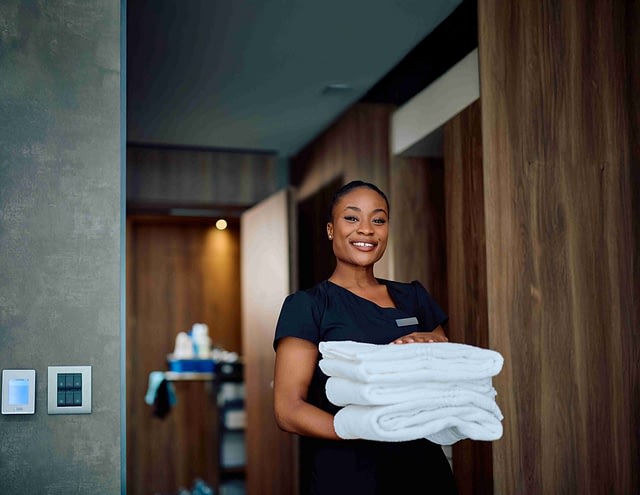
A woman coming with towels from laundry set up

Key challenges at a glance

  • Hotels processing over 85% machine capacity daily are operating beyond sustainable limits
  • Guest satisfaction drops 23% when fresh towels aren’t available within 30 minutes of request
  • Outdated laundry equipment uses 40% more energy than modern commercial systems
  • Peak season linen shortages indicate immediate need for capacity expansion
  • Maintenance costs exceeding £500 monthly per machine signal replacement requirements
  • Staff overtime costs often exceed new equipment lease payments within 6 months

Table of Contents

Guest experience warning signs

Where else to begin than with the most detrimental warning sign that your hotel laundry is no longer sufficient or equipped to handle current capacity – the impact this is having on the overall guest experience.

Hotel laundries are unique in that their performance, output, and results are public-facing. Thus, even the smallest daily inefficiencies can have a knock-on effect, with the potential to negatively impact your business in the short and long term.

If your laundry room is no longer delivering the results and efficiency your guests expect, you may encounter the following early warning signs…

Direct guest complaints about towel and linen availability and quality

As worst-case scenarios go, direct complaints from guests regarding the quality or availability of towels and linens are as bad as it gets. If your laundry simply cannot meet the demands that guests may have for spare towels or clean linens, this is the number one indicator that your laundry room setup needs addressing with immediate effect.

Of course, the quality of guest linens and towels also matters, particularly in well-rated hotels with a star rating and reputation to consider. If linens and towels are notably worn and threadbare through over-processing, this could indicate an issue with your inventory. Of course, it could also be a sign that your commercial washing machine or dryer is outdated and lacks the programmes needed to process different fabric types gently and safely.

Problems with room turnover times

The turnover process is critical in the smooth running of your hotel, as it ensures you can maintain your quoted check-in times. If, however, you regularly experience delays or are constantly down to the wire trying to turn rooms around, this could signal that your laundry room is at capacity and in need of an upgrade or two.

Think about it: if outdated or too-small laundry equipment is creating a bottleneck in your turnover cycle, this creates additional stress for your backroom hospitality staff. It could even mean delays at the check-in desk, as well as an overall drop in guest experience and in-room quality.

Another potentially unforeseen consequence of an inefficient room turnover process concerns resourcing and over-staffing. Your business could easily waste money on additional staff or overtime hours in an effort to mitigate scheduling issues, when, in reality, the problem could be solved at source by upgrading your commercial laundry equipment.

Operational efficiency red flags

While increased guest complaints are the worst-case scenario signalling a serious problem with your laundry workflow, the signs and symptoms can begin much sooner. Indeed, you may encounter efficiency red flags well before issues trickle down to the guest-facing level, but it’s important to deal with these sooner rather than later to mitigate their potential impact.

There are a variety of tell-tale signs that your current hotel laundry room setup isn’t as efficient as it might be. Let’s take a closer look at some of the most common issues that hoteliers and laundry room staff might face…

Equipment running for longer than expected – and still causing delays

If you and your staff find that you’re having to run wash and dry cycles on a near-continuous basis, this could indicate a capacity issue – especially if you’re still struggling to cope with demand. 

We cannot stress enough the importance of investing in commercial laundry equipment that is of the right capacity for your business. If your washing machine or tumble dryer isn’t rated for the average load weight that you regularly need to process, this will mean a more inefficient laundry workflow, with a greater number of cycles required to manage your overall daily throughput.

Hotel laundry rooms may experience capacity issues during peak times, or as a result of recent growth. So, upgrading your laundry setup may simply be a case of requiring bigger machines that can handle larger loads – ultimately helping to expedite your total processing times.

Staff working overtime to meet demand

As alluded to earlier, if you find that your staff are having to work overtime to meet demand, this could certainly signal an efficiency issue with your laundry room setup. There are a variety of negative knock-on effects, too, including:

  • Drop in staff morale as a result of busy and inefficient working conditions
  • Money wasted on overtime pay or additional recruitment needs
  • Overall drop in output quality, which could affect guest experience
  • Reduced standards across your laundry room – including hygiene and cleanliness
  • Damage or premature wear to laundry equipment as a result of inefficient, at-capacity operation

Manual, inefficient workarounds becoming the norm

Consider your current laundry room setup and workflow – are there any areas where you’re reliant on manual processes and non-standard workarounds that your team has had to implement due to equipment shortfalls?

It’s not uncommon for laundry room staff to seek on-the-fly solutions to day-to-day issues, especially if they’re struggling to keep pace with demand. This, however, puts efficiency, hygiene, and cleanliness at risk, as well as potentially subjecting your equipment to premature wear and tear.

Of course, this could also mean you’re missing out on the opportunity to automate key processes around your laundry room, be it auto-dosing laundry detergent or smart wash/dry cycles. There are a variety of modern laundry solutions which can help eliminate time- and resource-intensive processes from your laundry suite, speeding up processes and freeing staff up to focus on other areas of your operations.

Workflow disruption indicators across your wider business

Hotel laundry inefficiencies can easily spill out from your laundry room, affecting other areas of your business both directly and indirectly. Of course, the biggest issue is workflow disruption – when failings in your laundry suite impact other core offerings and services around your hotel.

Let’s take a closer look at some of the issues that might arise:

  • Housekeeping staff kept waiting for clean linens and towels before beginning the daily turndown process, impacting guest experience and scheduling.
  • Core departments, like spa facilities and restaurants, compete for towels and linens, putting undue stress on internal teams.
  • External laundry services are increasingly relied on to handle day-to-day laundry processing, reshaping how your business’ key workflows operate.

The financial impact analysed

Maintaining an optimal guest experience may be a priority, but the financial impact of a poorly performing hotel laundry room must be considered, too. Higher energy bills, unexpected costs, and dwindling profits can all stem from an outdated or at-capacity laundry suite, so let’s explore how inadequate laundry capacity can affect hotel finances.

The following cost comparison chart highlights the economic benefit of upgrading your hotel’s laundry room equipment…


Cost category

Ageing/overloaded setup

Modern efficient setup

Potential saving

Energy per kg processed

0.8–1.2 kWh/kg electrical

0.3–0.5 kWh/kg electrical

Up to 60%

Water usage

30-40 litres per kilogram

15-25 litres per kilogram

30–40%

Maintenance (% of RAV)

5–10%+

2–5%

Significant reduction

Staff overtime

Regular/mandatory

Occasional/seasonal only

Labour cost stabilised

Linen replacement cycle

Accelerated (premature wear)

Standard lifespan achieved

Lower annual replacement spend

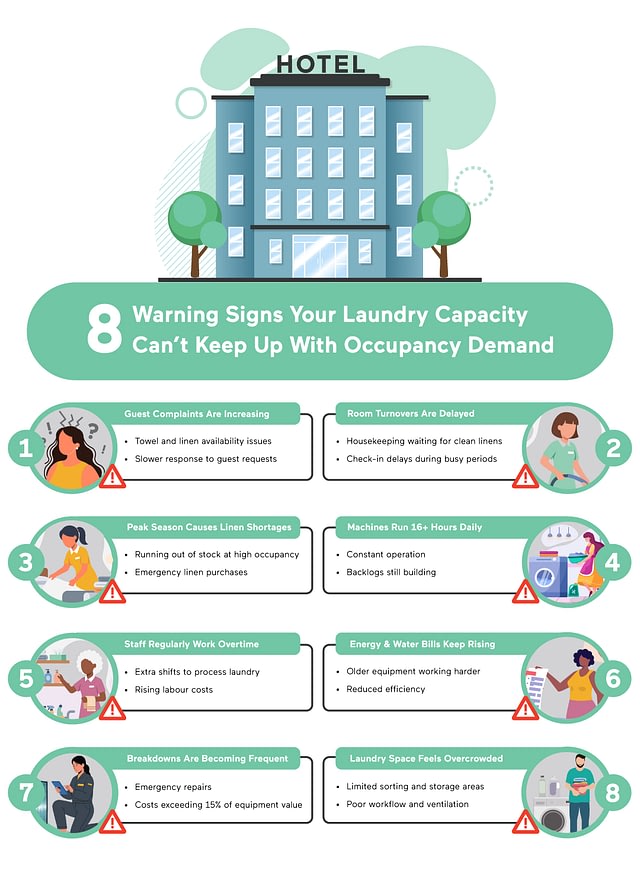
Infographics on Clear Signs Your Hotel Has Outgrown Its Current Laundry Setup

Equipment performance issues

While capacity is usually the key culprit behind hotel laundry room inefficiency, technical issues could be stymying performance too. 

If there’s an underlying fault with any of your equipment or your appliances haven’t been serviced and maintained regularly enough, then ongoing equipment performance issues could be behind recent poor results – perhaps signalling that it’s time for an upgrade.

The signs and symptoms of poorly performing laundry equipment include:

Issues

Explainer

Longer-than-expected cycle times

When a washing machine or tumble dryer develops a fault, this could materialise as longer-than-expected cycle times, with the potential to significantly impact your laundry workflow. 

Frequent breakdowns

Often find yourself at the mercy of temperamental laundry equipment that is prone to frequent breakdowns? Your business cannot afford extended downtime, so it could be time for an upgrade.

Inconsistent results

Hotel laundries need to deliver consistent results that reflect the establishment’s guest rating. If you’re not happy with your laundry room’s output, then outdated machinery could be the root cause.

Excessive noise and/or vibration

You need to provide a safe and healthy working environment for your staff, while ensuring that guest ambience isn’t compromised by noisy laundering activity. If any of your laundry appliances is making excessive noise or producing a lot of vibration, this could indicate a serious fault that needs addressing ASAP.

Occupancy vs required capacity benchmarks

Given that the majority of issues outlined in this guide come about as a result of inadequate laundry room capacity, we thought it would be useful to provide a rough industry benchmark that hoteliers can use to plan their next laundry room upgrade. Of course, this is rough, illustrative guidance only, so if you require bespoke help based on your exact requirements, the JLA team is always here to help.

Hotel size

Estimated daily linen volume

Minimum washer capacity needed

Key considerations

Up to 50 rooms

150–300 kg

2× commercial washers (16–24 kg)

Efficiency and space optimisation critical

50–150 rooms

300–900 kg

3–5× commercial washers (24–35 kg)

Dryer and ironer capacity must match

150–300 rooms

900–2,000 kg

Industrial-scale washer-extractors

High G-force extraction essential for throughput

300+ rooms

2,000+ kg

Full industrial laundry line

Complete system including ironers, folders, stackers

 FAQs

How do I calculate if my hotel's laundry capacity matches occupancy needs?

There are a variety of ways to calculate your hotel’s daily laundry capacity requirements. These include:

  • Calculate your average occupancy versus the total number of rooms
  • Weigh your daily laundry throughput over a typical seven-day laundry cycle, factoring in peak and off-peak occupancy periods
  • Lean on smart energy meter consumption data to help you figure out how regularly appliances are used

Provided you have a rough idea of your hotel’s average laundry throughput and your average weekly occupancy rate, it’s possible to calculate your total laundry capacity. Just make sure to leave around 10-20% headroom to account for peaks in demand or business growth. 

What's the average lifespan of commercial hotel laundry equipment?

High-quality commercial hotel laundry equipment should last 10-15 years depending on its average usage and whether it’s maintained and serviced within manufacturer guidelines.

When do maintenance costs justify equipment replacement over repairs?

If maintaining your hotel room’s laundry equipment has become a significant overhead, it may be time for an upgrade. For instance, if a single repair costs over 50% of the machine’s total value, this is definitely a sign that a replacement would be more cost-effective.

How quickly can new laundry systems be installed without operational disruption?

Very quickly, provided you opt for a professional installation. At JLA, our trained engineers will aim to deploy your new laundry equipment with minimal downtime and disruption, at a time that suits you. Of course, the actual installation time will vary depending on the work involved and the complexity of the install.

What energy efficiency improvements can modern laundry equipment provide?

We recently published a guide exploring the various ways that hotel laundry rooms can improve their energy efficiency by adopting modern commercial laundry equipment. Take a look at the full resource right here.

How does JLA's Total Care service compare to traditional equipment purchase options?

Total Care from JLA is designed to offer a complete, all-inclusive equipment procurement service, rather than simply a financing option. It offers brand-new equipment and professional installation, along with the following benefits:

  • Free equipment servicing and maintenance every year
  • 24/7 support from the JLA team
  • Access to myJLA for on-demand equipment reporting and monitoring
  • Emergency repair cover, with a guaranteed engineer response time within 8 hours

We hope this guide proves useful for hoteliers and laundry managers who may be struggling with an inefficient and at-capacity laundry room. If you decide it’s time to upgrade, contact our experts today on 0808 239 7578, and we’ll be happy to help.
George Barclay
  • George Barclay
  • Laundry Expert

Water and energy represent the biggest overheads that hotels face. So, finding ways to curb consumption and reduce bills in your commercial laundry room could be an effective way to start making inroads towards more cost-effective operational overheads.

As a business leader, you want to make the right, cost-effective decision when it comes to replacing critical equipment. But striking the balance between short-term affordability and long-term efficiency can be tricky, to say the least.

Here, we’re taking a closer look at the budget-vs-premium debate, giving you essential food for thought before you commit to a purchase decision. That includes the average cost of ongoing maintenance, servicing, and repairs, as well as a couple of useful formulas that can help you calculate your long-term ROI and your prospective payback period.

Old commercial laundry equipment

Key challenges at a glance

  • Cheaper equipment costs 3x more in maintenance and repairs over its lifetime
  • Energy-efficient commercial equipment reduces operating costs by up to 50% annually
  • Quality equipment lasts 15-20 years vs 5-7 years for budget alternatives
  • Total Care contracts eliminate upfront costs while providing premium efficiency
  • Downtime from cheap equipment failures costs businesses £500-£2,000 per day
  • Energy-efficient models may qualify for government incentives, reducing net investment

Table of Contents

The true cost of “cheap” commercial equipment

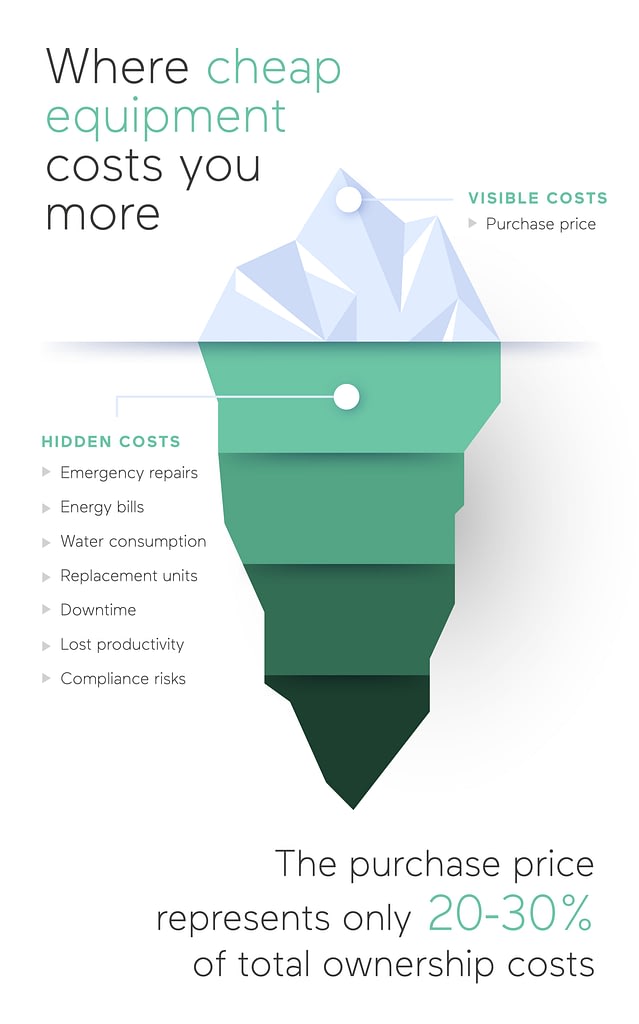
We recognise that opting for cheap replacement equipment might seem like the right step for your business. After all, with day-to-day budgeting pressures and short-term financial health to consider, choosing affordable over premium may provide some immediate headroom – shielding you from significant capital outlay.

However, selecting cheap equipment may not prove to be the smartest long-term strategy, particularly when you factor in running costs, more frequent maintenance and repair overheads, and a shorter overall equipment lifespan. 

Let’s take a closer look at some of the other hidden costs associated with inferior commercial equipment.

Hidden maintenance and repair costs

It doesn’t take a genius to figure out that affordable equipment will have a higher lifetime repair bill than the equivalent high-quality unit. Premium components and superior build quality generally mean that more expensive equipment will last longer and require fewer repairs, although preventative maintenance and servicing remain fundamental to optimising an appliance’s quoted lifespan.

With that said, here’s a direct comparison between budget and high-quality equipment, demonstrating the significant void in maintenance-related costs between the two.

Maintenance area

Budget equipment

Premium equipment

Annual preventative maintenance

£250-£500

£300-£600

Average reactive repair costs

£500-£1,500

£150-£600

Replacement parts

Cheaper replacement parts, needed more frequently

More expensive replacement parts, needed less frequently

Labour costs

Higher due to more frequent breakdowns

Lower to less frequent breakdowns

Downtime costs

High – significant risk of disruption and potential loss of earnings

Low – although risk of disruption and potential loss remains

Emergency call-outs

Plan for 2-5 call-outs a year

1-2 per year (0 if you’re lucky)

Expected service life

7-10 years

15+ years

Lifetime maintenance spend

£8,000-£15,000+

£3,000-£8,000

This chart demonstrates better than any other set of statistics just how seismic the void between budget and high-quality commercial equipment can be. By opting for budget equipment as a short-term cost-saving measure, you could stand to pay significantly more in the longer term – so, perhaps it’s better to take the hit and benefit from a more nominal lifetime maintenance spend?

Downtime impact on business operations

Downtime is one of the hidden costs associated with interior equipment, and it poses a detrimental risk to your business. The impact goes well beyond simple budgeting considerations, too, with the potential to cause disruption and continuity issues across your operations. 

Here are some examples of the ill-effects that equipment downtime can have on your business, reiterating the importance of opting for quality replacements versus cheap alternatives.

  • Significant reduction in productivity
  • Increased labour costs to pick up the strain in key areas of your business
  • Reduced capacity at critical points along your operational workflow
  • Customer dissatisfaction, compounded by poor reviews that could affect long-term revenue
  • Direct loss of earnings, placing significant strain on your cash flow
  • Compliance risk – bad news if you suspect a H&S inspection could be imminent

Long-term efficiency: The smart investment strategy

Even after seeing the potential saving figures written in black and white, some businesses may feel they have to take the short-term-thinking approach – even if it’s just as a way to protect their working capital and operational budget.

However – and if only to hammer home our point about seeing the bigger picture when it comes to investing in more expensive equipment – long-term efficiency and productivity are almost always better value than any savings you would make from opting for cheaper but ultimately inferior equipment. And it just so happens that there are a couple of formulas you can use to calculate this based on projected real-world savings.

How to calculate the ROI of your equipment purchases

The first formula we’d like to shine a light on is the basic ROI formula, which you can use to get a handle on the potential long-term financial benefits of a particular equipment purchase. 

ROI (%) = ((Total Financial Benefits − Total Investment Cost) ÷ Total Investment Cost) × 100

Of course, this requires you to have a pretty accurate understanding of the potential financial benefits of a particular appliance, which may be tricky to figure out on accurate, real-world terms.

So, instead, you might like to try the payback period formula, which can be used to get a gauge on when a new equipment purchase will have paid for itself in long-term savings.

Payback Period = Purchase Cost ÷ Annual Savings

Although the payback period formula also relies on an understanding of the total annual savings that new equipment will deliver, these figures should become obvious when you start using a particular appliance. You might like to lean on smart meter data or a machine’s in-built cycle tracker to attain the figures required to calculate your machine’s payback period accurately.

Energy savings analysis

With mounting energy costs and ESG (Environmental, Social and Governance) targets to consider, anything you can do to curb your electricity, gas, and water consumption could prove extremely beneficial – not least to your bottom-line profits.

The question is, how do high-quality appliances built for long-term efficiency compare to their cheaper equipment counterparts, purely from an energy savings perspective? Let’s take a look.

Cost metrics

Budget equipment

Premium equipment

Electricity/gas

Higher

25-40% lower

Water

Higher

30-50% lower

Carbon

Higher

Significantly reduced

Maintenance costs

Higher

Significantly reduced

Government incentives and tax breaks

Did you know that there are a variety of government incentives, tax breaks, and other relief schemes afforded to businesses that choose energy-efficient equipment? Such grants may offset the cost of purchasing more premium appliances, making your final budget-vs-premium purchase decision even simpler. 

Let’s take a closer look at some of the schemes and incentives you may qualify for…

  • Industrial Energy Transformation Fund (IETF): Available to energy-intensive businesses with industrial-grade equipment requirements, the IETF offers grants for purchasing efficient industrial machinery. Learn more.
  • Ofgem business energy grants and schemes: Ofgem provides a list of grants and incentives for UK SMEs and micro businesses. Learn more.
  • Local authority funding for decarbonisation efforts: Most local authorities have a pot set aside to help businesses with the green energy transition. Don’t be afraid to contact your local authority before making a new equipment purchase to see if you qualify for financial aid.

Total cost of ownership: The complete financial picture

When it comes to replacing equipment on your premises (or, indeed, investing in new value-add appliances), you need to look beyond the initial price tag and instead consider the total cost of ownership. This is the best way to approach the budget-vs-premium purchase decision, as it often provides a clear winner.

There are several different factors that you should consider when calculating the long-term cost of your commercial equipment. Taking this holistic view, you may feel differently about taking the perceived easy route and opting for the cheapest-possible option right off the bat.

Here’s a complete overview of the total cost of ownership (TCoO) of a single piece of equipment, ranked by its impact on how much you can expect to pay over time.

TCoO factors

Budget

Premium

Long-term impact

Initial purchase price

Low purchase price – immediate perceived benefit.

High initial purchase price.

Limited long-term impact – particularly with financing options.

Energy

Higher energy costs due to less efficient operation.

Lower energy costs thanks to higher efficiency.

High long-term impact, with significant savings possible.

Maintenance

Higher maintenance requirements, with potential for costly repairs.

Lower maintenance requirements, although preventative servicing is still needed.

Very high long-term impact, with significant savings possible.

Lifespan

Reduced overall lifespan, necessitating earlier replacement.

Longer overall lifespan.

Very high long-term impact, particularly if premature replacements are needed.

Cheaper Equipment vs Long-Term Efficiency: What Saves More in 2026?

Future-proofing your equipment investment

As we’ve alluded to at various junctures throughout this guide, any investment you make needs to be future-proofed with the right approach. This applies whether you’re purchasing premium equipment or taking the budget approach.

But what exactly constitutes “future-proofing” when it comes to commercial equipment? Here are a few tips and suggestions…

  • Commit to a strict maintenance and servicing schedule: Whether it’s a commercial washing machine or a new blast chiller for your catering business, preventative maintenance is key to future-proofing
  • Utilise digital monitoring capabilities: Many modern commercial appliances feature on-board digital monitoring capabilities. This allows you to monitor energy consumption, cycle performance, and maintenance/servicing information, all of which can prove exceedingly useful in optimising your equipment’s performance, efficiency, and lifespan.
  • Choose scalable equipment: We often emphasise the need to purchase equipment that offers a degree of scaling, so that it supports business growth and continuity over the lifetime of the product. That might mean opting for a commercial washing machine with more capacity than you currently require, for example.

 FAQs

How much can energy-efficient commercial equipment save on utility bills?

Energy-efficient commercial equipment can offer significant savings on energy bills versus budget appliances that don’t prioritise efficiency. Although the average savings will depend on the appliance in question, you’re typically looking at a 20-50% energy efficiency benefit.

What is the typical payback period for premium vs budget equipment?

You can use our formula to calculate the typical payback period you can expect from premium or budget equipment. It may be the case that more expensive equipment pays for itself faster than budget models, particularly when you incorporate prospective energy savings and reduced maintenance requirements.

How does Total Care compare to traditional equipment leasing?

Total Care is an all-inclusive equipment plan, incorporating everything from free installation and repairs to an annual service in line with manufacturer recommendations. You also get access to myJLA and JLA Connect, so you can easily control and manage your equipment.

What maintenance costs should I expect with cheaper equipment?

Cheaper commercial equipment may incur additional maintenance, servicing, and repair bills. You might wind up paying for replacement parts more regularly than you would with premium alternatives, while unexpected breakdowns can also bring about the hidden costs of equipment downtime.

Are there financing options for energy-efficient commercial equipment?

Absolutely! JLA offers a range of financing options across all its commercial equipment, including our beloved Total Care solution.

So, there you have it: cheap is cheap when it comes to commercial equipment, and you may wind up paying more over the lifetime of your appliance than you would with a premium model. Remember, too, that if you need to upgrade your equipment, JLA offers a range of financing options which can remove the need for a heavy initial outlay. Contact our experts today on 0808 239 7578 to discuss requirements.

George Barclay
  • George Barclay
  • Laundry Expert

Water and energy represent the biggest overheads that hotels face. So, finding ways to curb consumption and reduce bills in your commercial laundry room could be an effective way to start making inroads towards more cost-effective operational overheads.

Join our laundry room specialists for a detailed guide on how hotels can reduce their water and energy consumption by upgrading the appliances they rely on every day. We’ll look at the technologies that can be real difference-makers in your laundry space, before offering tips for selecting the right equipment to give your operations an efficiency-boosting lift.

Clean and ironed linen

Key challenges at a glance

  • Modern commercial laundry equipment uses 7-10 litres per kilogram of laundry compared to 10-13 litres in older systems
  • Front-loading commercial machines consume 60% less water than top-loading alternatives
  • Water reclamation systems can reduce hotel water usage by 30% annually
  • Heat recovery technology in commercial dryers cuts energy consumption by up to 50%
  • Smart load optimisation prevents waste and maximises efficiency per wash cycle

Table of Contents

Water conservation technologies in commercial laundry

Did you know that modern commercial washing machines are equipped with state-of-the-art technologies actively designed to reduce water consumption?

Recognising that water conservation is a priority for many of our customers, JLA has innovated a range of new features that conserve water cycle after cycle, even in the busiest hotel laundry suites.

Let’s take a closer look at some features that can help you reduce your water consumption.

Water recycling and reclamation systems

Water reclamation systems are designed to recycle grey water in commercial washers, reducing the need for fresh water at different stages of the cleaning cycle. These systems use state-of-the-art technology to treat and reuse water, ensuring that it can be recycled effectively without compromising hygiene, performance or results.

Smart load detection

Some JLA commercial washing machines feature smart load technology, which automatically weighs your load at the start of each cycle, adjusting the required water volume accordingly. Variants of this technology can also detect the material type, again adjusting the water volume to ensure it is optimised for the type of load. 

Front-loading vs top-loading commercial washing machines

Notice that all commercial washers featured at JLA are front-loading appliances – that’s no coincidence. Not only are front-loading machines much simpler and safer to operate, but their design actively contributes to water conservation and reduced energy consumption.

The design and setup of front-loading commercial washers is such that the drum is able to spin more efficiently and distribute water more evenly than on the equivalent top-loading appliances. That’s why all commercial and industrial washers designed and manufactured by JLA feature front-loading doors where applicable.

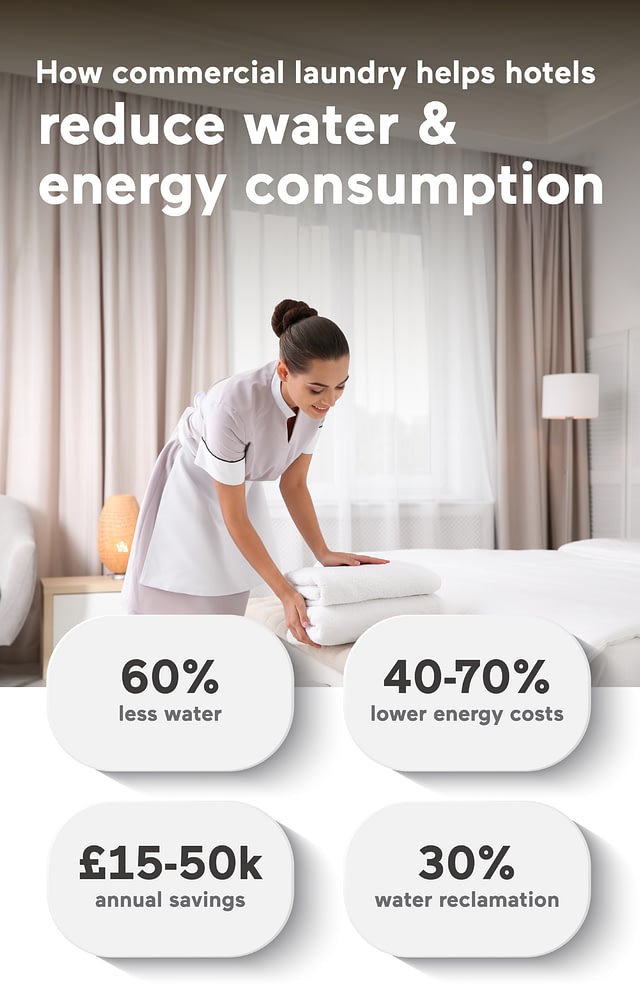
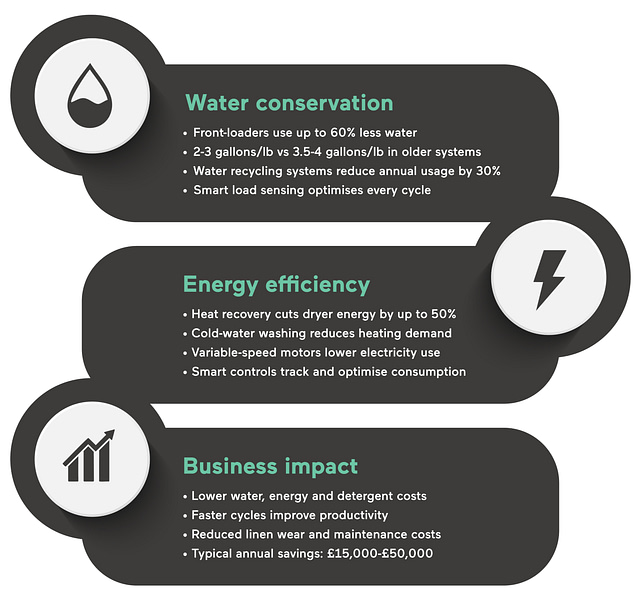
How Commercial Laundry Helps Hotels Reduce Water and Energy Consumption

Energy efficiency benefits of modern commercial equipment

Of course, efficient water management is only part of the equation for hoteliers and third-party laundry specialists. How laundries use and conserve energy is also a key priority for many businesses – particularly in the age where energy prices are almost exclusively on the rise.

So, how can JLA commercial washing machines and tumble dryers help you to save energy in your hotel laundry room? Let’s explore some of the technologies and features which are leading the charge against mounting energy prices.

Heat recovery systems

While heat generation is essential for efficient and hygienic laundering, there’s no getting around the fact that higher-temperature washing and drying cycles consume a significant amount of energy. As such, heat recovery systems have become the norm on modern commercial laundry appliances, greatly reducing the need for continual heat delivery during high-heat cycles.

Heat recovery technology takes several different forms depending on the application and the appliance in question. For instance, waste heat recapture is often leveraged as part of high-heat laundry wash cycles, while heat pump technologies are increasingly being used in commercial tumble dryers.

Cold water washing technology

Historically, hotels relied on high-heat wash cycles to ensure maximum hygiene and cross-contamination prevention. But in recent years, several cold-wash innovations have emerged, eliminating the need for high heat to eliminate harmful bacteria and contaminants.

The best example of this is JLA’s OTEX Ozone disinfection system, which eliminates harmful micro-organisms even on a cold wash. Relied on by hospitals, care homes, and healthcare facilities, the OTEX system is ideal for hoteliers seeking maximum hygiene and cleanliness from their laundry operations.

Variable speed motors and smart controls

The emergence of variable speed motors, coupled with smart controls, means that professional launderers now enjoy maximum control and flexibility when selecting laundry programmes and cycles. This makes it much easier to get the results you want while maintaining peak efficiency and performance – essential in hotel laundry rooms which process a wide variety of different materials and linens as part of their day-to-day operations. 

Of course, there have been specific advancements to commercial laundry systems that have made all programmes significantly more efficient. For instance, most JLA commercial washers now feature G-force spin speeds, which help to extract significantly more water, contributing to reduced drying times.

Cost savings through optimised commercial laundry operations

Hoteliers big and small prioritise cost savings as part of their operations. So, optimising the commercial laundry process with more efficient appliances is just one way to ensure that your business isn’t missing out on any opportunities to save money and reduce operational overheads. 

Here are some of the unique ways that upgrading your hotel’s laundry room could lead to significant cost savings.

Cost-saving opportunity
Explainer

Water reduction

Water bills are increasing year on year in the UK, so finding ways to reduce your overall water consumption is always a smart move. By investing in new commercial laundry equipment with built-in water-saving technologies, you can shave pounds and pence from your laundry’s total annual water bill.

Energy reduction

As alluded to throughout this guide, energy reduction is the key to curbing your energy bills and managing monthly overheads. Switching to a modern appliance may seem like a significant outlay, but the long-term energy savings will almost definitely offset your expenditure.

Detergent savings

Commercial washing machines are designed to optimise detergent use, ensuring peak performance and results from the smallest doses. Add to that the emergence of smart auto-dosing pumps for commercial laundries, and you can make significant savings on your total monthly detergent bill.

Reduced labour costs

More efficient equipment can contribute to a streamlined laundry room, with fewer staff required to manage daily cycles safely and effectively. This could ultimately help you to save on labour costs while benefitting from happier and more productive laundry personnel.

Reduced wear on linens

One of the lesser-known advantages of upgrading your commercial laundry equipment is reduced wear on linens, towels, and flatwork. With improved programmes, lower temperatures, and optimal detergent dosing, modern laundry appliances can help extend the life of hotel linens, reducing the need for costly replacements.

Extended equipment life

Reduced cycle times, less heat-intensive operation, and smoother motor performance all contribute to extending the life of your new commercial laundry equipment. This, in turn, helps to reduce maintenance and servicing costs, too, so you benefit from more predictable and reliable operation over the lifetime of your appliance.

Choosing water and energy-efficient commercial laundry equipment

So, you’re up to speed on what new commercial laundry equipment can do for your hotel business. Now it’s time to offer some tips and insights that should steer you in the right direction when it comes to investing in new washers, dryers, and other appliances for your commercial laundry.

Equipment specification and capacity planning

One of your core priorities is to ensure that you invest in new commercial laundry equipment that is suitable for your unique capacity requirements. Here’s a quick-reference chart detailing average per-room laundry capacities, so you can plan accordingly.


Hotel type

Laundry per occupied room per day

Budget hotel

4-6 kg

Mid-range hotel

6-9 kg

Luxury hotel

9-14 kg

Resort or spa

12-18 kg


With these figures, it’s possible to calculate your average daily laundry volume by multiplying the per-room laundry weight by the number of rooms in your establishment. For example…

  • A budget hotel with 25 rooms has an occupied laundry volume of 100-150 kg per day
  • A luxury hotel with 100 rooms has an occupied laundry volume of 900-1,400 kg per day
  • A resort or spa with 10 rooms has an occupied laundry volume of 120-180 kg per day

Although only a ballpark estimate, calculating your average daily laundry capacity in this way can help you to determine your required equipment setup. Be sure to account for 10% headroom in case of increased capacity needs, too – otherwise, you could find yourself seeking an upgrade sooner than you’d like.

Technology features for maximum efficiency

If boosting efficiency is one of the main reasons why you’re upgrading your commercial laundry, then it makes sense to prioritise features which actively assist in optimising your day-to-day laundry cycles. We’ve touched on several of these throughout this guide, but key capabilities to look for include:

  • Programmable controls and cycle optimisation
  • Automatic detergent dosing systems
  • Digital monitoring and reporting capabilities
  • Integration with hotel management systems

Financing and procurement options

Here in 2026, it’s no longer necessary to purchase commercial laundry equipment outright. Not only can this place significant strain on your short-term budgets, but it could wind up delaying essential upgrades, compounding existing issues and meaning you miss out on efficiency-boosting changes to your hotel laundry room setup.

At JLA, we’ve devised a variety of equipment purchase and leasing options to suit a range of businesses – from boutique B&Bs to high-end hotels with dozens of rooms. Our flagship service is Total Care from JLA, which gets you the equipment you need plus a range of benefits, including:

  • No upfront outlay required – simply pay a fixed sum each month
  • All-inclusive servicing, maintenance, and repairs
  • Free installation of brand-new laundry equipment
  • Access to digital tools like myJLA, making it easier to manage your equipment and identify key areas for improvement
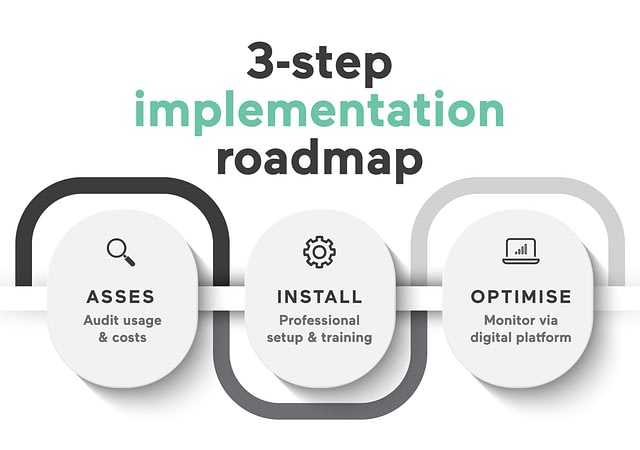
3-Step Implementation Roadmap

 FAQs

How much water can hotels save with efficient commercial laundry equipment?

It’s challenging to put an actual figure on the amount of water hotels can save by switching to new commercial laundry equipment. However, industry figures suggest that modern appliances use 20-40% less water than older models, which is a lot when averaged over your full day-to-day operations.

What is the payback period for investing in energy-efficient commercial washers?

Typically, a new washing machine deployed in a hotel laundry room will have paid for itself in 3-5 years depending on your average usage and capacity. This accounts for water and energy savings, coupled with reduced maintenance, servicing, and repair costs.

Do water-efficient commercial laundry systems clean as effectively as traditional equipment?

Yes, absolutely. As mentioned earlier, water-efficient commercial washing machines often feature technologies like OTEX ozone cleaning. This particular feature offers a deep hygienic clean even on cold wash cycles, helping you to save money and reduce your environmental footprint.

How does JLA Total Care support water and energy conservation goals?

Total Care from JLA can support your water and energy conservation goals by ensuring that your equipment is always working at its optimal best. With on-demand help and support included in the price of your plan, you can keep on top of your equipment’s maintenance and servicing, so appliances work at their most efficient for longer.

What maintenance is required for water recycling systems in hotels?

Water recycling systems require significant maintenance and oversight to ensure they’re performing safely and efficiently in hotel laundry suites. This includes a daily, weekly, and monthly servicing schedule, and one that combines leak checking, pipework inspections, and the regular cleaning of traps and filters.

So, there you have it, a complete guide on how hotels can reduce water and energy consumption by upgrading their commercial laundry equipment. If you’re a hotelier or a laundry room manager, contact the commercial laundry experts at JLA today for more information on upgrading your equipment. Simply call 0808 239 7578 to get started.

George Barclay

Laundry expert

Since joining JLA as an apprentice engineer in 2011, George has built extensive hands-on experience across plumbing, electrical and mechanical engineering, and now oversees laundry design and project delivery as our Head of Installations.

George’s career progression has given him detailed knowledge of commercial laundry operations, from on-site practicalities to meeting compliance standards. He is Gas Safe and COMCAT 1, 2, 3 and 5-qualified , and holds IOSH Managing Safety and 18th Edition accreditation.

From new laundry rooms to existing site upgrades, George’s expertise ensures that every project is completed safely, efficiently and with minimal disruption, so that operations can perform reliably from day one.

Recent Posts

  • Clear Signs Your Hotel Has Outgrown Its Current Laundry Setup
  • Cheaper Equipment vs Long-Term Efficiency: What Saves More in 2026?
  • How Commercial Laundry Helps Hotels Reduce Water and Energy Consumption
  • How to Make Your Business Fully Fire Safety Compliant
  • Food Safety Standards in Commercial Kitchens: Essential Equipment that Helps You Comply

Recent Comments

    Archives

    • August 2026
    • July 2026
    • June 2026
    • May 2026
    • April 2026
    • March 2026
    • February 2026
    • January 2026
    • December 2025
    • November 2025
    • October 2025
    • September 2025
    • August 2025
    • July 2025
    • June 2025
    • May 2025
    • April 2025
    • March 2025
    • February 2025
    • January 2025
    • December 2024
    • November 2024
    • October 2024
    • September 2024
    • August 2024
    • July 2024
    • June 2024
    • May 2024
    • April 2024
    • March 2024
    • February 2024
    • January 2024
    • December 2023
    • November 2023
    • October 2023
    • September 2023
    • August 2023
    • July 2023
    • June 2023
    • May 2023
    • April 2023
    • March 2023
    • February 2023
    • January 2023
    • November 2022
    • October 2022
    • September 2022
    • July 2022
    • June 2022
    • May 2022
    • April 2022
    • March 2022
    • December 2021
    • April 2021
    • February 2021
    • January 2021
    • December 2020
    • November 2020
    • October 2020
    • September 2020
    • August 2020
    • July 2020
    • June 2020
    • May 2020
    • February 2020
    • November 2019
    • October 2019
    • September 2019
    • July 2019
    • May 2019
    • April 2019
    • March 2019
    • January 2019
    • September 2018
    • May 2018
    • October 2017
    • August 2017
    • May 2017
    • April 2017
    • March 2017
    • August 2016
    • May 2016
    • March 2016
    • February 2016
    • August 2015
    • July 2015
    • June 2015
    • May 2015
    • March 2015
    • January 2015
    • November 2014
    • May 2014

    Categories

    • Catering
    • Energy saving
    • Fire safety
    • General
    • HVAC
    • Hygiene
    • Laundry
    • Testimonials

    Meta

    • Log in
    • Entries feed
    • Comments feed
    • WordPress.org
    Need help? Call us on

    01422822282

    Facebook Linkedin
    PQAL & Black on White UKAS 27001 Logo
    Cyber Essentials Plus Certified
    About JLA
    • Who we are
    • Careers
    • ESG at JLA
    • Accreditations
    • Blog
    • Total Care from JLA
    • Testimonials
    • Who we are
    • Careers
    • ESG at JLA
    • Accreditations
    • Blog
    • Total Care from JLA
    • Testimonials
    Solutions
    • Commercial laundry equipment
    • Catering equipment
    • HVAC
    • Fire safety
    • Infection Control
    • Commercial laundry equipment
    • Catering equipment
    • HVAC
    • Fire safety
    • Infection Control
    Sectors
    • Care Homes
    • NHS & Healthcare
    • Health clubs
    • Holiday parks
    • Hospitality
    • Hotels & spas
    • Housing
    • Facilities management
    • Football clubs
    • Pubs & restaurants
    • Equine and Stables
    • Vets & animal care
    • More sectors
    • Care Homes
    • NHS & Healthcare
    • Health clubs
    • Holiday parks
    • Hospitality
    • Hotels & spas
    • Housing
    • Facilities management
    • Football clubs
    • Pubs & restaurants
    • Equine and Stables
    • Vets & animal care
    • More sectors
    • Privacy & cookies
    • Terms & conditions
    • Modern slavery
    • Covid-19
    • Responsibility
    • Site map
    • Privacy & cookies
    • Terms & conditions
    • Modern slavery
    • Covid-19
    • Responsibility
    • Site map

    Get my quote

    By clicking Get my quote, you agree to the Terms and Conditions set out by this site, including our Privacy Policy

    George Barclay

    George Barclay

    Laundry Expert

    Head of Installations George joined JLA as an apprentice service engineer in 2011. With years of experience in plumbing, engineering, electrical and mechanical engineering, he oversees the delivery of safe, compliant installations.

    George is Gas qualified for both laundry and COMCAT 1, 2, 3, 5, and holds IOSH Managing Safety and 17th edition accreditation.

    Read George's full profile

    Get my quote

    By clicking Get my quote, you agree to the Terms and Conditions set out by this site, including our Privacy Policy