

Gas Safety Week is back for 2026, with the annual event scheduled to run from 14th-20th September. The theme for this year’s event is “Take No Chances”, which reinforces the message that there’s no second-chance saloon where gas safety is concerned.
Join our specialists for a closer look at Gas Safety Week 2026, as we highlight the importance of an effective commercial gas safety strategy. We’ll look at the practical steps you can take to improve the safety of your gas appliances, along with the most common faults and violations that affect a surprising number of businesses across the UK.
Key takeaways
- Annual campaign runs Monday 14 September to Sunday 20 September 2026
- Only Gas Safe registered engineers can legally work on commercial gas appliances
- Commercial landlords face legal requirements for annual gas safety certificates
- Carbon monoxide poisoning causes approximately 50 deaths annually in the UK
- Regular maintenance reduces gas appliance breakdown risk by up to 80%
Table of Contents
What is Gas Safety Week September 2026?
Initially launched way back in 2011, Gas Safety Week empowers businesses and individuals to take a fresh approach to gas safety. Whether that’s performing additional safety checks, understanding the risks posed by gas-powered equipment, or enforcing the importance of gas-monitoring equipment in commercial premises – the event is a time to reflect on the risks posed by unsafe gas appliances.
If you’d like to learn more about Gas Safety Week 2026, along with practical tips and guidance on how to get involved, be sure to check out the Gas Safe Register website.
Why gas safety matters for commercial businesses
From commercial cooker hobs to HVAC components like boilers and hybrid heating systems – gas plays a vital role in the UK commercial sector. But with a business to run and customers to attend to, when was the last time you considered the safety of gas appliances on your premises?
During day-to-day operations, gas safety is easy to overlook. It may be that you’ve put off having an appliance serviced during a busy trading period, or simply that equipment has developed a small fault that so far has gone undiagnosed.
Either way, unsafe gas appliances pose a significant risk to your business, as well as its people, clients and customers.
Let’s explore some of the facts and statistics associated with faulty, damaged or poorly maintained gas-powered commercial equipment…
- It’s estimated that around 16% of commercial catering premises in the UK feature unsafe gas appliances. Could your kitchen be one of them?
- According to the latest figures, only 50% of commercial premises are broadly compliant with current gas safety legislation.
- Gas Safe Register investigations in 2020–21 identified 3,168 defects classed as At Risk (AR) or Immediately Dangerous (ID). 37% were attributed to registered businesses and 63% to unregistered fitters.
- HSE says around seven people die each year on commercial premises from carbon monoxide poisoning caused by gas appliances and flues that have not been properly installed, maintained or adequately ventilated.
- It’s thought that regular maintenance reduces gas appliance breakdown risk by up to 80% – highlighting the need for increased servicing and timely fault diagnostics.
What are the legal requirements for commercial gas safety?
Commercial gas appliances must comply with Gas Safety (Installation and Use) Regulations 1998 (GSIUR), the primary gas safety legislation for England, Scotland and Wales. That’s on top of additional health and safety legislation, including the Health and Safety at Work Act 1974.
The primary takeaways of the GSIUR are as follows:
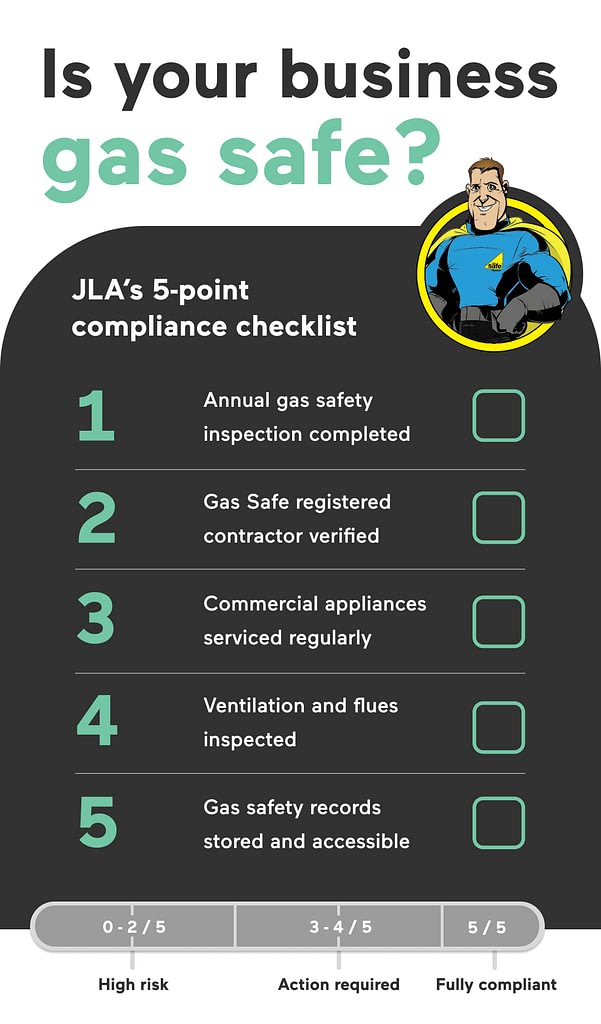
- All work on commercial equipment must be undertaken by a Gas Safe registered engineer.
- Gas appliances must be professionally installed, maintained and serviced on commercial premises. It’s not possible to service or maintain gas-powered equipment yourself.
- Regular inspections are required to minimise the risk of leaks, damage, and premature wear and tear.
- Adequate ventilation is required, including the installation of new flues and extractor units to make safe areas where gas appliances are in use.
- Safety devices like carbon monoxide alarms must always be used in close proximity to gas-powered commercial equipment.
- Businesses should maintain appropriate records of inspections, servicing, repairs and defects.
Essential gas safety checks for commercial properties
In light of Gas Safety Week 2026, not to mention the approaching autumn/winter season (when gas is more widely used), now is the ideal time to carry out essential gas safety checks on your premises. So, here’s a checklist of inspections to add to your to-do list – or else to delegate to a trusted Gas Safety engineer during a planned maintenance visit.
Daily visual inspections
Get in the habit of checking gas appliances whenever you use them. From the condition of a pilot light to the presence of lingering odours – there are several tell-tale signs that equipment may be faulty or in need of servicing, so it’s important to remain vigilant and make routine checks a part of your daily equipment workflow.
Professional annual inspections
Perhaps Gas Safety Week 2026 is the ideal opportunity to book a service and inspection with a Gas Safe registered engineer? If it’s been 12 months since your equipment was last checked and tested, you’re legally required to schedule a maintenance inspection with an accredited engineer.
Did you know that JLA offers professional gas safety checks? Our Gas Safe registered engineers can test, inspect, service, and maintain all commercial gas equipment on your premises, so why not get a quote and book your next inspection with our specialist team?
Creating a gas safety action plan
If nothing else, Gas Safety Week 2026 puts the importance of gas safety in the spotlight, and that can only be a good thing. Indeed, we’d say it’s the perfect time to reframe how you approach equipment safety on your premises, and the opportune moment to create a gas safety action plan.
Immediate actions for Gas Safety Week
There are things you can do this Gas Safety Week to improve gas safety on your commercial premises. For example…
- Book an inspection of your gas appliances with a Gas Safe registered engineer
- Verify that your current maintenance contractors and third-party suppliers are Gas Safe registered
- Review and update emergency evacuation procedures for gas incidents
- Schedule outstanding annual safety inspections before year-end
- Hold a staff briefing on gas smell recognition and emergency contact procedures
Building a long-term gas safety strategy
Gas Safety Week isn’t designed as a flash-in-the-pan initiative. It’s a chance to reframe your long-term approach to gas safety on your premises, implementing strategies and changes that will ensure consistent compliance and safety moving forward.
With that in mind, consider adding these measures to your long-term gas safe action plan…
- Improve how you report and document changes to gas-powered equipment. This ensures optimal compliance, improved traceability, and more effective long-term fault monitoring.
- Establish fixed servicing, inspection, and maintenance intervals with a Gas Safe registered engineer.
- Develop a more comprehensive staff training plan around gas safety.
- Budget for equipment upgrades and improvements that will improve your business’s gas safety infrastructure.
Common gas safety violations in commercial properties
Gas safety violations follow a similar pattern in commercial properties. Typically, they stem from poor ventilation, inadequate maintenance and servicing, damaged pipework or connections, and improper installation.
Let’s take a closer look at some of the most common issues that can crop up on commercial premises gas safety inspections.
Issue | Why it’s a problem | Potential consequences |
Inadequate maintenance | Poorly maintained and serviced gas equipment is more liable to develop faults, which could have disastrous consequences. | Gas leaks, fires, CO poisoning, and even explosions may occur. |
Inadequate ventilation | Blocked or poorly maintained ventilation systems can have a knock-on effect on gas appliances, significantly increasing the risk. | Hazardous CO accumulation, poor or reduced equipment performance, and a significant risk of fire. |
Damaged pipework and connections | During day-to-day operation, it’s easy for gas pipework to become damaged, corroded, or snagged, posing a major risk to gas safety. | Gas leaks may occur, with a significant risk of fire. There may also be an accumulation of CO, with long-term effects for staff. |
Improper installation | Not only does improper installation pose a risk to gas safety, but it could also mean that your business isn’t compliant with GSIUR. | Significant risk from gas leaks, along with the legal ramifications associated with non-compliance. |
FAQs
What gas safety checks are legally required for commercial properties?
Gas safety checks must be completed in line with GSIUR legislation. Typically, this means having all gas-powered appliances inspected by a Gas Safe registered engineer at least once a year.
How often must commercial gas appliances be inspected by Gas Safe engineers?
Commercial gas appliances must be inspected at least once every 12 months by a Gas Safe registered engineer. You may wish to increase this interval where gas appliances are heavily used, however.
What should I do if I smell gas in my commercial building?
If you can smell gas, immediately stop what you’re doing and call the National Gas Emergency Service on 0800 111 999.
In the meantime, if it’s safe to do so, ventilate the space, switch off all equipment, and evacuate the premises.
Who can legally carry out gas work on commercial catering equipment?
Only a Gas Safe registered engineer can carry out work on commercial gas appliances, including catering equipment. Never carry out work yourself, and always check the credentials of suppliers before permitting them to service, inspect, or maintain your equipment.
What are the penalties for non-compliance with commercial gas safety regulations?
In commercial properties, non-compliance with gas safety regulations could result in enforcement notices, prosecution and substantial fines. In light of the most serious offences, you may even face imprisonment.
With Gas Safety Week 2026 right around the corner, now is the perfect time to take a moment to consider your business’s gas safety strategy. Remember, if you need any help with inspections, maintenance, or equipment upgrades, the expert Gas Safety registered specialists at JLA are here to help. Call us today on 0808 239 7578 and we’ll take care of it.