
Investing in a complete fire protection solution means enhanced detection, suppression, and emergency planning capabilities. This can ensure long-term compliance, reduce your insurance premium, and provide peace of mind for you and your team.
Commercial fire safety equipment offers next-gen protection for your business, helping to protect critical assets while offering future-proof compliance. Here, we’re taking an in-depth look at the key components of a complete fire protection solution, along with key considerations and factors that could affect your purchase decision.
Key takeaways
- Fire risk assessment determines which protection systems your business needs
- Integrated solutions combining detection, suppression, and emergency systems provide comprehensive coverage
- Professional installation and ongoing maintenance are essential for system effectiveness
- Compliance with The Regulatory Reform (Fire Safety) Order 2005 is mandatory for UK businesses
- Total Care contracts eliminate capital costs while ensuring expert maintenance and compliance
- Industry-specific solutions address unique risks in hospitality, healthcare, and manufacturing sectors
Table of Contents
Understanding your business fire protection requirements
A complete fire protection solution integrates active and passive fire safety equipment to provide comprehensive coverage, protecting what matters most. Your solution might include detection, suppression, and emergency systems, all of which are aimed at reducing the potential for widespread damage from flame and smoke.
The question is, how do you decide on your business’ fire protection requirements? And what are the most common fire risks by business type?
Conducting a professional fire risk assessment (FRA)
A fire risk assessment (FRA) is the first step in deploying comprehensive fire protection measures for your business. Carried out by a fire safety specialist, this process identifies the most at-risk areas of your operations, so that the right equipment and processes can be deployed where they’re most needed.
New businesses may not be aware that carrying out a FRA is a legal requirement under the Regulatory Reform (Fire Safety) Order 2005. It falls to your business’s “Responsible Person” to arrange the FRA, with most enterprises opting for a third-party professional to undertake the work on their behalf.
As part of an FRA, fire safety inspectors will:
- Identify potential fire hazards like dangerous substances and sources of ignition
- Identify personnel and groups who may be at risk from fire, drawing up a detailed action plan
- Work back from the worst-case scenario, implementing fire-safe equipment and protocols to mitigate damage and reduce risk
- Draw up an emergency fire risk management plan that’s unique to your business. This will include recommended equipment, along with escape routes and evacuation plans
JLA provides commercial fire risk assessments, with our trained specialists able to provide guidance and advice on all aspects of fire protection and enhanced control measures.
Common fire risks by business type that may appear on your FRA
While the results of your FRA are unique to your business, there are certain hazards, risks, and pain points which fire safety inspectors will look out for depending on your company sector. Let’s take a look at some examples of common fire risks by business type.
Business type | Potential fire risk |
Hotels & hospitality | From kitchen fires to guest evacuation routes – FRAs for hotels and hospitality venues are multifaceted and complex. Guest and staff safety is a priority for fire safety officials, with an emphasis on emergency lighting and comprehensive escape route planning. |
Healthcare facilities | With reduced in-patient mobility, oxygen-rich environments, and the critical protection of life-saving equipment, healthcare facilities pose serious challenges for fire safety. |
Manufacturing centres | Fire risk assessors typically highlight chemical stores, overheating machinery, and flammable materials as the most at-risk areas of manufacturing centres. |
Office buildings | Electrical equipment, paper storage, and evacuation routes are a priority in office environments. Of course, serviced office buildings containing multiple businesses present an even bigger challenge for fire safety officials. |
Essential components of a complete fire protection solution
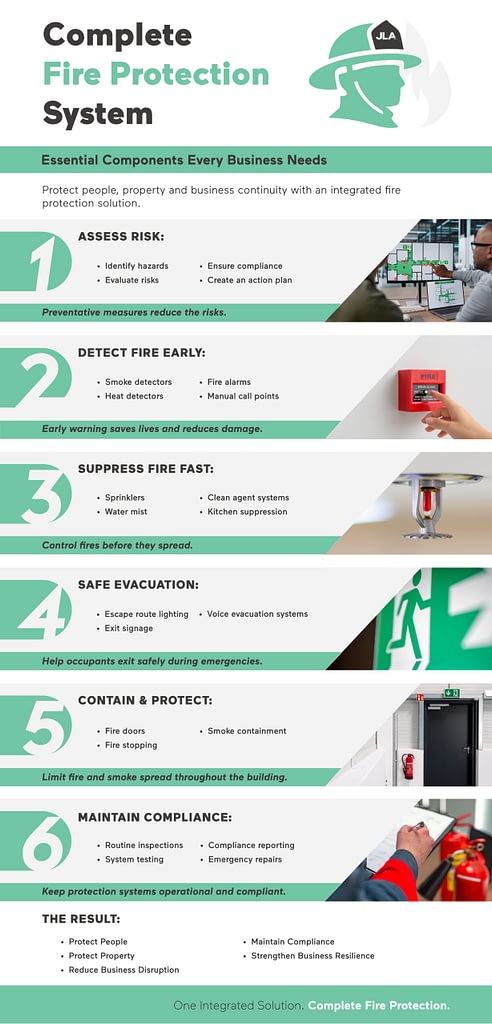
There’s no one-size-fits-all fire protection solution to suit every type of business, so your requirements may differ depending on your business and premises. However, there are similarities between the components that typically appear in a complete fire protection solution, including:
- Fire detection and alarm system
- Fire suppression system
- Emergency lighting and evacuation
These are the three core components that make up a full and complete commercial fire protection plan. Let’s take a closer look at each of these categories in turn.
Fire detection and alarm system
Early detection is the first line of defence against fire, making detection and alarm systems critical to your business’ fire protection solution.
Modern fire detection systems offer advanced early warning capabilities, including smoke detection, heat sensors, and automatic temperature monitoring. Such systems can also be controlled and monitored remotely, while also syncing directly with emergency services to instantly raise the alarm.
Fire suppression system
The next phase of fire protection involves suppressing flames and smoke. Suppression is a catch-all term for a variety of fire safety equipment used to tackle fires head-on, reducing how quickly they can spread to other areas of your business.
Fire suppression has come a long way since the days of automatic room sprinklers (although these remain a useful tool as part of a wider solution). There are now a wide variety of flame and smoke control products to suit your business type, each offering unique benefits and characteristics.
Let’s take a closer look at some of the typical suppression systems used as part of a commercial fire protection system.
Suppression type | Best for | Key advantage | Consideration |
Sprinkler systems | General commercial premises | Proven, cost-effective, activates when heat is detected | Water damage to contents |
Water mist systems | Heritage buildings, hotels, offices | Reduces water usage by 50–90% while suppressing fires effectively | Higher-pressure equipment required |
Clean agent (HFC227ea / Novec 1230) | Server rooms, data centres, museums | HFC227ea systems use clean agent gas for sensitive equipment – no residue | Higher upfront and recharge costs |
Kitchen suppression | Commercial kitchens | Rapidly suppresses grease fires on cooking equipment | Requires regular cleaning and inspection |
Foam systems | Flammable liquid storage, fuel sites | Effective on flammable liquids | Environmental impact and cleanup considerations |
Emergency lighting and evacuation
Escape route planning is a critical component in any fire protection solution, even in cases where there are very few staff onsite. As part of your business’ FRA, risk assessors will map out your premises and plan the safest evacuation routes, factoring in at-risk personnel, visitors, and guests.
Planned fire evacuation routes typically require the following:
- Emergency escape lighting meeting BS5266 standards
- Exit signs and wayfinding systems
- Voice alarm systems for clear evacuation instructions
- Evacuation alert systems for high-rise buildings
Your evacuation plan will be unique to your business, and must be managed, maintained, and overseen by the Responsible Person within compliant limits. In serviced commercial premises, coordination with onsite management teams is essential in clarifying evacuation plans and undertaking key exit routes.
Key factors when choosing your fire protection system
While your fire protection system will be dictated largely by the results of your FRA, there are some key factors at play that will hold sway over the scope of your system and, ultimately, how much it’s likely to cost.
Building size and layout considerations
The size and layout of your premises will have a significant impact on the complexity of your fire protection solution, and the exact components and features required.
That’s not to say that large premises will require more complex fire safety systems than smaller buildings by default. The presence of open-plan vs compartmentalised spaces can have a significant impact on the scope of your system, while ceiling heights, access routes, and the presence of integrated HVAC systems can also dictate the controls and components you’ll need.
Regulatory compliance requirements
There is a suite of regulatory compliance orders that your building must comply with to maintain legal fire protection status. Here’s a quick rundown of the current laws governing regulatory fire safety compliance in the UK, not all of which may apply depending on your location:
- Regulatory Reform (Fire Safety) Order 2005 – primary fire-safety law in England & Wales.
- Building Regulations 2010 – Approved Document B – fire safety in building design/construction.
- Fire Safety Act 2021 – additional fire-safety duties, particularly for multi-occupied buildings.
- Fire Safety (England) Regulations 2022 – specific requirements for residential buildings.
- Scotland: Fire (Scotland) Act 2005.
- Northern Ireland: Fire and Rescue Services (Northern Ireland) Order 2006.
Those are only the basic countrywide regulations that commercial premises will need to adhere to to maintain fire safety compliance. There may be other industry-specific standards and certifications at play in your sector, while insurance companies may require specific fire safety solutions as part of your ongoing policy, too.
Budget and financing options
A comprehensive fire protection solution is a non-negotiable fact of life for business owners. However, that doesn’t mean that such systems are free from purchase and maintenance costs, which you’ll need to factor into your short- and long-term operational budget.
If you’re concerned about the financial ramifications of installing a new fire protection solution, there are ways to offset the cost and avoid hefty upfront outlay. For instance, Total Care from JLA can be used to deploy new fire safety equipment, offering all-inclusive installation, servicing, and support, all for a fixed monthly fee.
It’s worth noting, too, that upgrading your current fire protection setup could actually save your business in other areas – chiefly its annual insurance premium. Vendors may offer a reduced renewal quote in light of recent fire safety upgrades, potentially offsetting at least some of the cost of new equipment.
Implementation and maintenance considerations
From installation and servicing to ongoing testing – your on-site fire protection solution will require total oversight and proactive maintenance to ensure it’s always working at its best. With that in mind, let’s take a look at the installation process, as well as the ongoing servicing requirements of your commercial fire safety solutions.
Outlining the professional installation process
Onboarding a new fire safety system happens in phases, each managed by your assigned fire protection partner. These phases include:
- Phase 1: Site survey and detailed system design. Here, fire safety specialists will attend your premises, designing a bespoke solution that targets key hazard points identified as part of your FRA.
- Phase 2: Coordinated installation, minimising business disruption. Your new fire protection solution will be installed at a time that suits you, avoiding peak business hours to mitigate potential disruption and downtime where possible.
- Phase 3: Commissioning and testing. This is when your attending fire safety engineer will test the new system thoroughly, ensuring it’s fully operational and working as intended.
- Phase 4: Staff training and handover documentation. This is the final part of your fire protection solution rollout, in which fire safety officials will liaise with you and your team to offer guidance on the new system. You’ll also receive the necessary certification to prove full compliance, which may be useful when dealing with insurers.
Ongoing maintenance and testing
To ensure that your fire protection solution remains fully compliant and in sound working order, it’ll need to be tested on a fixed schedule.
Weekly alarm testing is recommended at a designated time each week, while a full monthly fire alarm and evacuation test is also required. You should also look to have your fire system tested annually by an accredited service engineer.
Selecting the right fire protection partner
It’s important to choose a competent, accredited, and reliable partner for your fire protection upgrades. Here are some attributes to look for when comparing different service providers:
- BAFE certification and industry accreditations
- NSI approval for security and fire systems
- Evidence of manufacturer authorisations and training
- 24/7 emergency response and repair services
- National coverage and local support teams
- Digital monitoring and remote diagnostics capabilities
Tip: Check your insurance policy for any reference to specific protection partner requirements. You may be required to work with fire safety specialists with BAFE certification and other industry accreditations, so the third-party provider must meet these requirements so as not to invalidate your policy.
FAQs
What components make up a complete fire protection solution?
A fire protection solution incorporates detection, suppression, and evacuation equipment. That includes everything from emergency lighting and fire extinguishers to a fire alarm control panel (FACP).
How much does a complete fire protection system cost for a typical business?
It’s difficult to put an average figure on the cost of a fire protection system, as this can vary significantly depending on the size and layout of the premises, the complexity of the system, and the specific risks it’s safeguarding against.
How often do fire protection systems need maintenance and testing?
Fire systems should be tested weekly by the Responsible Person in your business. Further testing and maintenance should be performed monthly, with a professional service performed at least once a year by a fire safety practitioner.
Can I finance fire protection equipment instead of purchasing outright?
Absolutely! For example, JLA Total Care can be used to finance new fire protection equipment for a fixed monthly cost with no initial outlay.
How long does it take to install a complete fire protection system?
That depends on the complexity of the work involved and the scope of the system. Rest assured that fire-safe engineers will work as quickly as possible to ensure that the installation doesn’t result in unexpected downtime and delays.
Investing in a new fire protection solution for your business is always money well spent. If you’re looking to upgrade your on-site fire safety provisions, JLA can help. We can assess, install, and maintain fire protection solutions on your premises, and offer a mix of accreditations from industry bodies. Get help today by calling 0808 239 7578.

Mark Bone
Operations Director Mark joined JLA in 2019 and now manages the delivery of turnkey fire safety and security systems designed to protect people, premises and critical assets.
Drawing on his extensive technical, commercial and customer service experience, Mark helps clients with everything from system selection and project planning to ongoing maintenance, ensuring they can navigate complex operating challenges.
In a shifting regulatory landscape, Mark also provides a wealth of safety-first guidance, with a particular focus on reducing risk and strengthening compliance across every site.