

Behind every professional kitchen is a suite of appliances that help chefs and caterers deliver exceptional food for their diners. But there’s another element to consider besides culinary flair, and that’s the relationship between catering equipment and food safety standards.
If you’re new to the catering industry and are still getting up to speed on the scope of UK food safety and compliance, this guide may help. Here, our experts are exploring the essential equipment that professional caterers rely on to ensure optimal compliance and safety, specifically those related to HACCP and other core food safety regulations.
Key takeaways
- Temperature monitoring equipment prevents foodborne illness outbreaks
- Commercial dishwashers with NSF certification ensure proper sanitisation
- HACCP-compliant refrigeration maintains critical food storage temperatures
- Digital monitoring systems provide audit trails for health inspections
- Proper ventilation equipment controls contamination and air quality
- Food prep equipment with antimicrobial surfaces reduces cross-contamination risks
Table of Contents
Understanding food safety standards for commercial kitchens
Naturally, for most catering professionals reading this guide, the fundamentals of food safety in commercial kitchens will be well and truly ingrained. If, however, you’ve only recently ventured into the catering field – perhaps after setting up your own street food pop-up or similar – then a primer on the need-to-know essentials of food safety may be in order.
So, before we look specifically at the equipment that you’ll come to rely on to maintain optimal compliance, here’s an overview of the UK’s current food safety legislation for commercial kitchens.
Overview of HACCP principles and equipment requirements
HACCP, or Hazard Analysis and Critical Control Points, is the gold standard in preventive food safety management. Indeed, it’s more than that – it’s a legal requirement among UK commercial catering professionals.
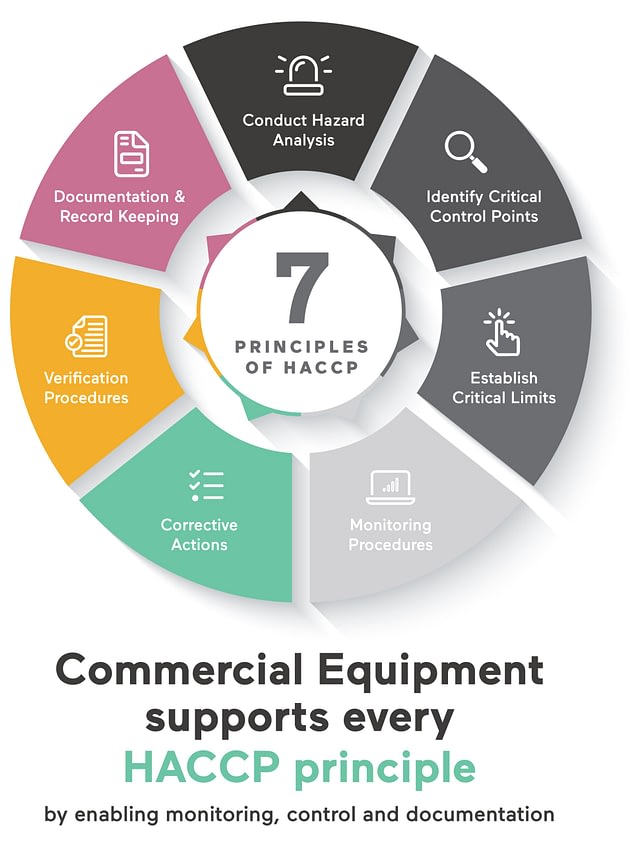
There are seven basic principles within the rubric of the HACCP, including:
- Conduct a hazard analysis
- Determine critical control points
- Establish critical limits
- Establish monitoring procedures
- Establish corrective actions
- Establish verification procedures
- Establish documentation and record-keeping
These are the core pillars of what HACCP commercial kitchen compliance is rooted in. Beyond that, there are also equipment-related requirements which fall within the remit of HACCP guidelines – governing everything from refrigeration and storage to preparation, allergen control, cooking equipment, and standard maintenance requirements.
It’s highly recommended that kitchen staff and other key stakeholders receive professional training on HACCP requirements. Courses are available from Level 1 to Level 3 in HACCP food safety compliance, so, though not technically a legal requirement, they can be supremely beneficial in aiding your kitchen’s long-term compliance moving forward.
Other notable compliance requirements for new catering vendors
Beyond the scope of the HACCP, UK-based food vendors face a series of additional – and mandatory – compliance and regulatory requirements. For example:
- You must register your catering business with a local authority at least 28 days before your initial trading date.
- Traceability is essential in maintaining full compliance within the catering industry. As such, it’s important to commit to meticulous record-keeping from the word go to avoid any compliance-related hiccoughs moving forward.
- Accredited staff training in key food safety disciplines is essential. Food safety inspectors will want to see documented training provisions for each food handler on your team.
That’s not an exhaustive look at the compliance-related requirements of commercial kitchens, but it should give you an idea of the scope of regulations and standards that apply. The Food Standards Agency is your one-stop resource for guidance, expertise, and services relating to food safety in the commercial sector.
Temperature control and monitoring equipment
Now that we’ve covered some of the basics of food safety standards for commercial kitchens and caterers, it’s time to move on and look specifically at the equipment that can help you achieve full compliance within your business. And where else to start than with temperature control and monitoring equipment, arguably some of the most critical equipment in your arsenal?
The importance of temperature control equipment in food hygiene
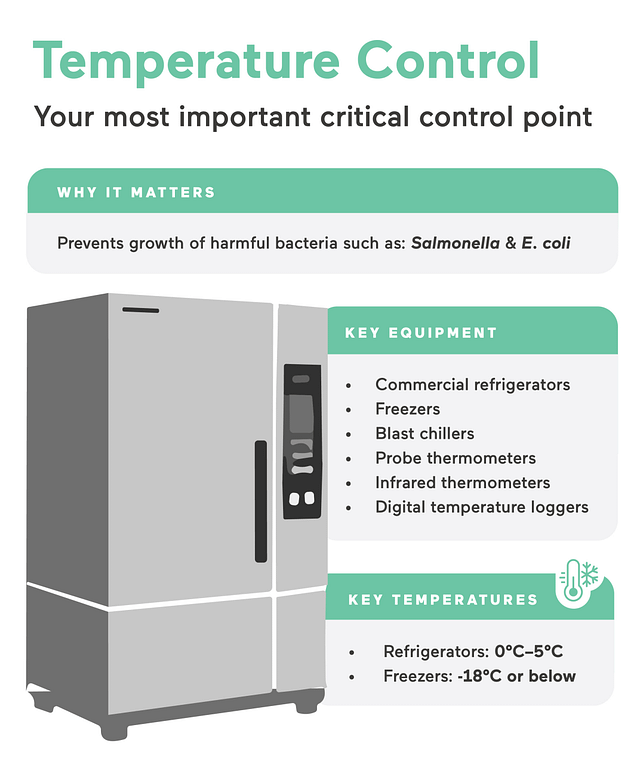
Of all the commercial kitchen equipment required by your catering business, temperature control equipment is the most important. Why? Because it actively helps to prevent the growth of harmful microorganisms, including foodborne – and potentially lethal – bacteria like Salmonella and E. coli.
Within the remit of HACCP, temperature control is considered a key Critical Control Point (CCP). It’s here where safe temperatures are maintained, monitored, and controlled, ensuring that food is stored and cooled to a hygienic and compliant standard.
Examples of temperature control and monitoring equipment
Naturally, the most obvious pieces of equipment to mention here are commercial refrigerators and freezers. These appliances preserve perishable food at safe temperatures of 0-5°C (fridges) and -18°C or below (freezers) respectively, helping to prevent the growth of harmful microorganisms, while keeping meals and ingredients fresh.
Of course, there is a wide range of sub-product categories to consider when kitting out our catering business with temperature-control equipment. Blast chillers, for example, are perfect for cooling perishable goods in a matter of minutes, while salad counters and bottle chillers can help you diversify your refrigeration setup to deliver the best combination of food hygiene and diner experience.
Temperature monitoring technology
Since temperature control is a CCP, you’ll need to adopt accurate monitoring systems to ensure that your appliances are maintaining safe temperatures. It’s important to be able to access and store such data, too, so you can easily identify and fix issues within your catering workflows.
There are, of course, a wide range of temperature monitoring tools available to professional caterers – from simple infrared probe thermometers to digital loggers that transmit essential temperature control information to linked devices. This ensures seamless temperature control, monitoring, and oversight, while also helping with health inspection documentation.
Sanitisation and cleaning equipment
One of the pillars of HACCP and its role in commercial kitchen compliance is adequate sanitisation and cleaning equipment. This extends from colour-coded cleaning cloths to commercial dishwashers that utilise thermal disinfection technology to maintain peak compliance and hygiene standards at every stage of your catering workflow.
The importance of sanitisation and cleaning equipment in HACCP
It doesn’t take a genius to figure out why sanitisation and cleaning equipment are absolutely critical within the remit of HACCP food safety standards. Not only does it help to prevent cross-contamination around your commercial kitchen, but it helps to control biological hazards, while maintaining food-safe equipment and supporting individual CCPs.
Environmental health officers (EHOs) will look carefully at your sanitisation equipment, along with the procedures, processes, and records affiliated with it. So, whether you’re investing in a pass-through dishwasher for heavy-duty use or introducing colour-coded mops and buckets, it’s essential that this equipment is correctly serviced, maintained, and supplied.
The scope of sanitisation equipment in commercial kitchens
Keeping a commercial kitchen clean requires a full scope of different equipment, supplies, and processes. For example, standalone utensil washers may be needed in large-scale professional kitchens with a high service turnover rate, while basic provisions like scouring pads and commercial vacuum cleaners are just as critical in maintaining peak hygiene levels.
Of course, whenever and wherever you introduce new professional kitchen cleaning equipment, staff training is essential. You’ll need processes in place for day-to-day cleaning and maintenance, as well as dedicated staff for handling industrial warewashers safely and efficiently.
Food preparation and storage equipment
The surfaces on which you and your team prepare food, as well as the counters, cupboards, and containers in which you store ingredients and dry goods, are absolutely central to compliant food safety standards. Let’s take a closer look at this key area of HACCP compliance.
Why food prep and storage equipment is important to HACCP compliance
Preventing cross-contamination is the central factor in effective food preparation and storage. For instance, by utilising stainless steel surfaces with antimicrobial properties, you can significantly reduce the risk of contamination from different foods – essential during busy service periods.
It’s worth noting, once again, that food prep and storage equipment is considered a CCP within the remit of HACCP. As such, things like sealed containers, non-porous surfaces, and well-maintained storage cupboards are critical in ensuring you retain regulatory compliance.
Examples of food prep and storage equipment in commercial kitchens
As you can imagine, there are a raft of appliances, tools, and resources which fall within the category of food prep and storage equipment. For example, high-quality cutting boards and utensils are critical for safe food preparation, while professional catering furniture ensures adequate safe storage for ingredients, dry goods, and other business-critical foodstuffs.
Ventilation and air quality systems
While ventilation and air quality systems may not immediately jump to mind when you consider commercial food safety and compliance, they play an important role in maintaining a safe, hygienic environment. Indeed, such systems are integral to HACCP safety standards, helping to:
- Reduce the risk of airborne contamination
- Control heat and humidity to prevent condensation and moisture, which could lead to bacterial growth
- Prevent contamination from grease, smoke, and harmful cooking vapours
- Safeguard overall food quality and safety
Examples of HVAC equipment used in commercial kitchens
Although it may not directly impact your day-to-day workflows, ventilation and air quality equipment is critical in helping to safeguard peak food safety and compliance. And there are a variety of different systems that you can deploy to ensure this, including…
- Kitchen exhaust hoods with proper CFM (cubic feet per minute) ratings
- Grease management systems for fire safety compliance
- Air filtration systems to prevent contamination
- Makeup air units for balanced ventilation
Digital monitoring and compliance management
The emergence of digital monitoring solutions for commercial kitchens has been a major leap forward for the industry. No longer are businesses reliant on manual auditing and monitoring processes, which can take up significant time and resources.
The arrival of remote monitoring, IoT-enabled (Internet of Things) equipment, and real-time temperature alerts has made it significantly simpler to maintain compliance and ensure you’re prepared for your next food safety inspection.
For example, an integrated asset management platform like myJLA makes it easy to track your equipment and keep compliance-related documentation in one place. Paired with remote monitoring equipment, such systems provide an invaluable partner for your operations.
Equipment maintenance for ongoing compliance
Investing in new commercial kitchen equipment isn’t the only way to achieve optimal food safety and compliance. Regular equipment maintenance and servicing are also of the essence, ensuring that your appliances are always delivering the hygiene-boosting performance you expect.
Without regular servicing, you can easily overlook issues that put your compliance and food safety standards at risk. For instance, if your commercial refrigerator has developed a fault, it may not be cooling food to a safe temperature within an acceptable time period.
Given the importance of equipment maintenance for ongoing compliance, it’s recommended that you seek a catering equipment service contract. This offers total peace of mind and timely resolutions should things go wrong, all while helping you to meet your legal obligations.
It’s worth noting, too, that if you opt for JLA Total Care when acquiring new commercial catering equipment, you’ll get the benefit of all-inclusive servicing, maintenance, repairs, and installation, along with access to the myJLA asset management platform.
FAQs
What commercial kitchen equipment is required for HACCP compliance?
There are ten key equipment categories within HACCP guidelines, including:
- Temperature control equipment
- Refrigeration and freezing equipment
- Cooking and reheating equipment
- Food preparation equipment
- Cleaning and sanitisation equipment
- Hand hygiene equipment
- Food storage equipment
- Ventilation and air quality equipment
- Allergen control equipment
- Monitoring and record-keeping equipment
How can digital monitoring help during health inspections?
Digital monitoring is the ultimate ally during routine food safety inspections, providing accurate record-keeping, traceability, and accountability. It makes inspections more efficient, too, minimising disruption and the time it takes to prepare.
What happens if my kitchen equipment fails a health inspection?
That will depend on the severity of the failure, the breach involved, and the scope of the issue. In some cases, corrective action may be required, or equipment may need to be taken out of use. Food and goods may also need to be discarded of, while you may face more severe penalties for serious food safety breaches.
Are there financing options for compliance equipment upgrades?
Certainly – there’s no need to pay for compliance equipment upgrades, or, indeed, commercial kitchen equipment, outright. For example, you might like to use JLA Total Care to get the equipment you need with no upfront outlay.
If you need help managing the compliance and safety of your commercial catering equipment, the experts at JLA can provide invaluable guidance and support. Contact us today on 0808 239 7578 to get started.